California DMV Practice Mock Exam 2
All 20 questions from Mock Exam 2, with answers and explanations.
A mixed exam: 5 sign questions, 5 road diagrams and 10 questions on the rules of the road, including safe driving and hazards, lanes and turns and parking and backing.
These are the 20 questions from Mock Exam 2, original practice questions on signs and the rules of the road, checked against the California Driver Handbook. Read through them with Show answer, or take the exam online first with the answers hidden and see your score. No sign-in needed.
These are original practice questions, not actual DMV test questions. Each links to the California Driver Handbook so you can check the rule. Questions were last reviewed in November 2026; read how we write and check them.
Question 1 · Right of Way and Crossings
A school crossing guard tells you to stop while your traffic light is green. What should you do?
- A. Drive around the guard.
- B. Follow the crossing guard’s lawful directions.
- C. Go if the person behind honks.
- D. Ignore the guard whenever your signal is green.
Show answer
Answer: B. Follow the crossing guard’s lawful directions.
A crossing guard controls the crossing; a green signal does not justify disregarding the guard.
Question 2 · Parking and Backing
You park beside a bicycle route and want to get out. What should you do before opening the door?
- A. Open immediately to claim space.
- B. Ask a passenger to watch for traffic and open the door when they tell you it looks clear.
- C. Look in the mirror and turn to look behind for cyclists and cars, then open the door slowly.
- D. Assume parked cars cannot create a hazard.
Show answer
Answer: C. Look in the mirror and turn to look behind for cyclists and cars, then open the door slowly.
A door swung open into a bike lane is a common cause of serious cyclist injuries. A quick look back first prevents it.
Question 3 · Alcohol, Drugs and Distraction
You keep yawning and missing road signs on a long drive. What should you do?
- A. Open the window and turn up the music, then keep going until your next planned stop.
- B. Leave the road at a safe spot and take a real break or nap before driving on.
- C. Turn up music as a substitute for rest.
- D. Drive faster to finish sooner.
Show answer
Answer: B. Leave the road at a safe spot and take a real break or nap before driving on.
Drowsiness slows reactions and can cause brief micro-sleeps. Cold air, music or caffeine only mask it for a moment; real rest is the fix.
Question 4 · Sharing the Road
A stopped emergency vehicle has its warning lights on beside your lane. What should you do?
- A. Move over when safely possible and slow as required for the roadside hazard.
- B. Stop beside the emergency vehicle to watch.
- C. Use the shoulder to pass responders.
- D. Keep your speed and stay in your lane.
Show answer
Answer: A. Move over when safely possible and slow as required for the roadside hazard.
Roadside emergency activity requires space and reduced risk; comply with applicable move-over requirements.
Question 5 · Signs and Signals
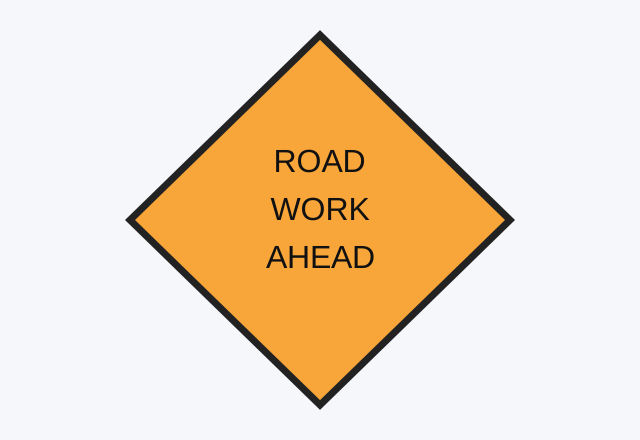
The illustrated ROAD WORK AHEAD sign faces your lane. What is the appropriate response?
- A. Reduce risk by slowing as needed and following temporary controls.
- B. Maintain speed past all workers.
- C. Ignore flaggers when your traffic light is green.
- D. Follow only permanent lane markings.
Show answer
Answer: A. Reduce risk by slowing as needed and following temporary controls.
Work zones can change lanes and hazards. Follow applicable temporary traffic control.
Question 6 · Signs and Signals
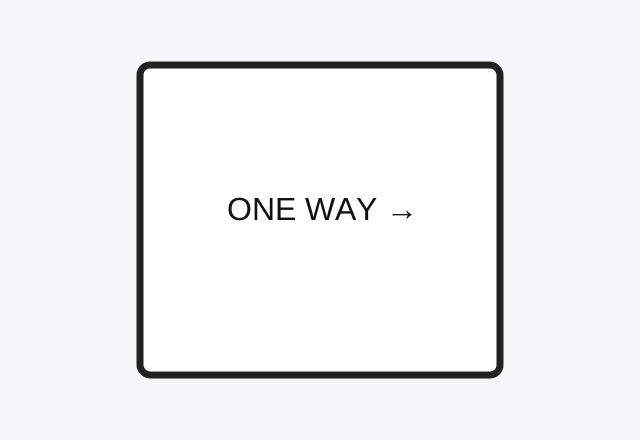
The illustrated ONE WAY → sign faces your lane. What is the appropriate response?
- A. Treat it as a passing instruction.
- B. Follow the arrow only during rush hour.
- C. Travel only in the direction indicated by the arrow.
- D. Use either direction when the street is empty, keeping to the right side.
Show answer
Answer: C. Travel only in the direction indicated by the arrow.
A one-way sign defines the permitted traffic direction.
Question 7 · Right of Way and Crossings
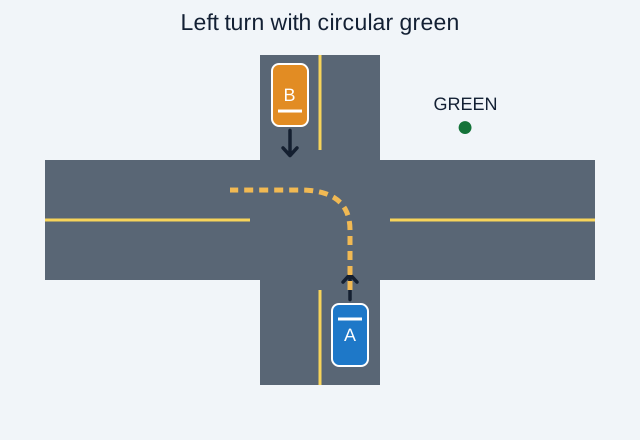
A faces north and wants to turn left. B approaches southbound, going straight. Both have a green circular signal and their paths conflict. What should happen next?
- A. A may turn first because A signaled and reached the intersection before B did.
- B. A turns across B immediately.
- C. A waits for B, since oncoming traffic going straight has the right of way.
- D. B must stop and wait for A.
Show answer
Answer: C. A waits for B, since oncoming traffic going straight has the right of way.
A left turn on a circular green is not protected against oncoming through traffic.
Question 8 · Lanes and Turns
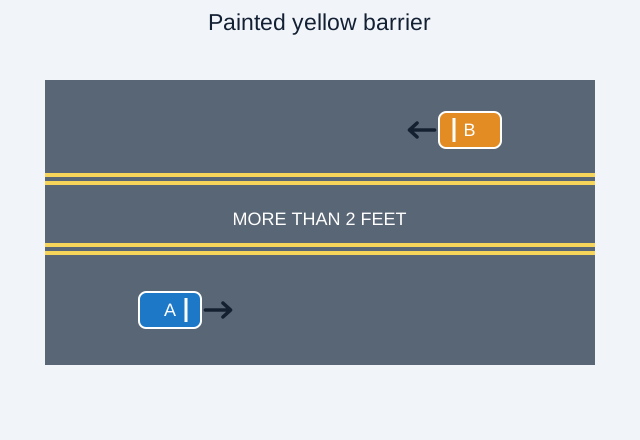
A wants to turn left across a wide painted median. Each edge of the median is a pair of solid yellow lines, and the edges are more than 2 feet apart. No gap is marked. What should happen next?
- A. Cross whenever no car is visible.
- B. Do not cross the painted barrier.
- C. Cross to save distance.
- D. Treat it as an ordinary shared turn lane.
Show answer
Answer: B. Do not cross the painted barrier.
A median outlined this way works like a concrete divider. Don't drive on it or turn across it; use a marked opening further along.
Question 9 · Signs and Signals
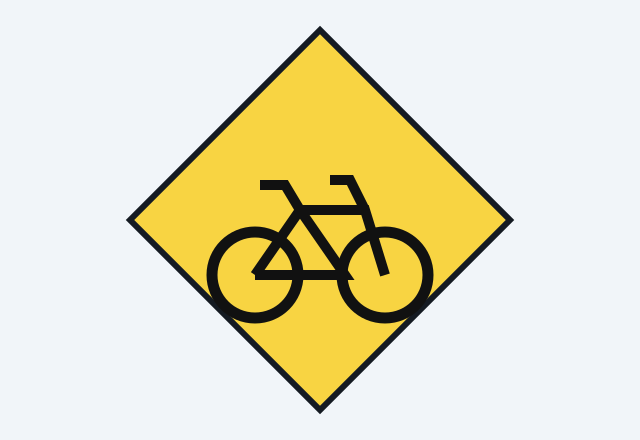
The illustrated BICYCLE CROSSING sign faces your lane. What is the appropriate response?
- A. Pass without checking the adjacent lane.
- B. Expect bicycles only on the sidewalk, not in the travel lanes.
- C. Look for bicyclists and leave safe space.
- D. Use the bike lane as a passing lane.
Show answer
Answer: C. Look for bicyclists and leave safe space.
The warning highlights bicycle activity. Check for riders before turning or changing position.
Question 10 · Safe Driving and Hazards
A visiting child is too small for an adult belt to fit correctly. What should you arrange?
- A. Use the adult seat belt, adjusting the shoulder strap so it sits below the child's neck, and put them in front.
- B. Assume the front seat is always safest.
- C. Use a correctly installed restraint appropriate to the child and current California requirements.
- D. Let an adult hold the child.
Show answer
Answer: C. Use a correctly installed restraint appropriate to the child and current California requirements.
Child restraint choice depends on applicable age, size and installation requirements; an adult’s arms are not a restraint.
Question 11 · Sharing the Road
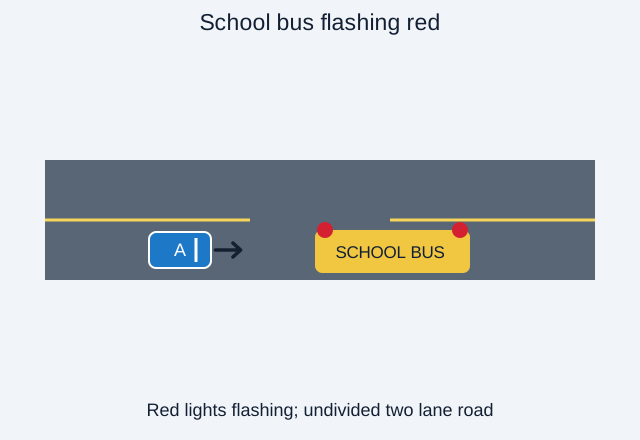
A follows a school bus stopped with red warning lights flashing on an undivided two-lane road. What should happen next?
- A. A may pass slowly, at walking speed.
- B. A passes after sounding the horn.
- C. A halts and does not move again until the bus's red lights go dark.
- D. A passes if no child is visible.
Show answer
Answer: C. A halts and does not move again until the bus's red lights go dark.
Blinking red lights on a school bus mean children may be crossing. On a two-lane road without a divider, traffic in both directions must stop and wait.
Question 12 · Signs and Signals
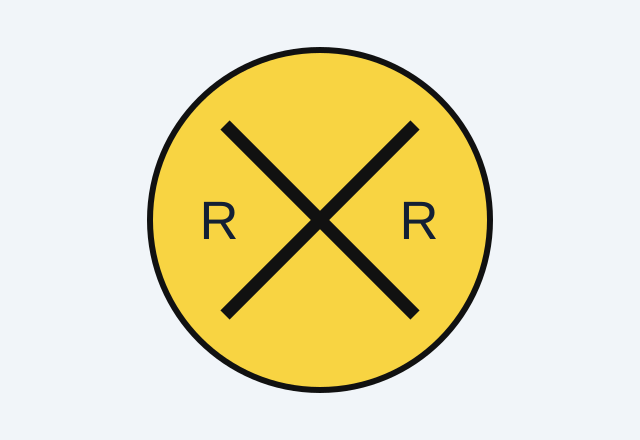
The illustrated RAILROAD CROSSING sign faces your lane. What is the appropriate response?
- A. Reduce speed, check both ways for a train, and be prepared to halt before the tracks.
- B. Slow down only if the crossing has gates.
- C. Race any approaching train.
- D. Stop on the rails to look both ways.
Show answer
Answer: A. Reduce speed, check both ways for a train, and be prepared to halt before the tracks.
This round yellow sign warns of a rail crossing ahead. Approach at a speed that lets you stop short of the tracks if a train is coming.
Question 13 · Signs and Signals
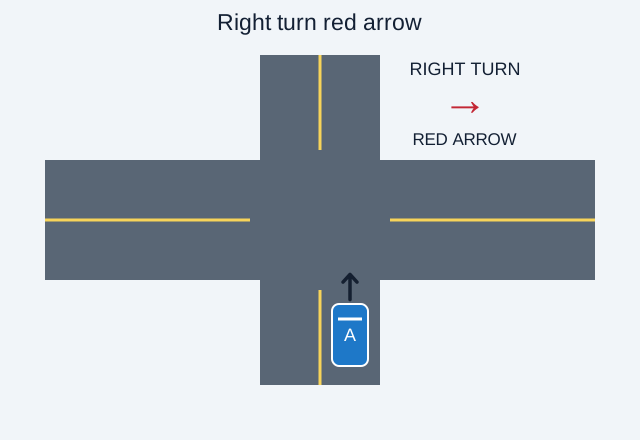
A is in a right-turn lane controlled by a red arrow pointing right. The crosswalk and road appear empty. What should happen next?
- A. A turns once the traffic on the left has cleared.
- B. A keeps waiting at the line until a green arrow or green light allows the turn.
- C. A turns after a full stop.
- D. A treats the arrow as a flashing yellow.
Show answer
Answer: B. A keeps waiting at the line until a green arrow or green light allows the turn.
Unlike a red ball, a red arrow does not allow a turn after stopping. Wait for a green indication even when the road looks empty.
Question 14 · Safe Driving and Hazards
The vehicle ahead brakes suddenly on a damp road. What preparation best reduces your collision risk?
- A. Stay exactly one car length behind at every speed, so other drivers can't cut in.
- B. Leave enough time and distance to react safely.
- C. Follow closely to prevent merging.
- D. Watch only the lead car’s bumper.
Show answer
Answer: B. Leave enough time and distance to react safely.
Following space should allow a safe response to sudden changes; increase the margin when conditions worsen.
Question 15 · Signs and Signals
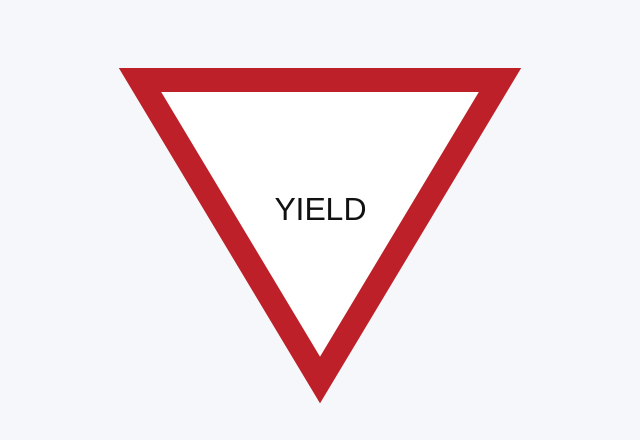
The illustrated YIELD sign faces your lane. What is the appropriate response?
- A. Always enter first.
- B. Treat it as permission to pass.
- C. Keep your speed and continue through.
- D. Give way to conflicting traffic and stop if necessary.
Show answer
Answer: D. Give way to conflicting traffic and stop if necessary.
Yield control requires giving priority to conflicting traffic; stopping is necessary when a safe gap is unavailable.
Question 16 · Safe Driving and Hazards
A busy shopping street has parked cars, driveways and crossing pedestrians. How should you use your eyes?
- A. Keep your eyes fixed on the lane markings just ahead of your car so you stay centered.
- B. Let navigation replace observation.
- C. Shift your attention regularly between the road far ahead, your mirrors and both sides.
- D. Watch only the car immediately ahead.
Show answer
Answer: C. Shift your attention regularly between the road far ahead, your mirrors and both sides.
Moving your eyes every couple of seconds lets you spot a door opening, a child stepping out or a car backing out early enough to respond.
Question 17 · Signs and Signals
A signal flashes red at a quiet intersection. How should you respond?
- A. Proceed without slowing.
- B. Wait at the line until the signal changes to green, even when no other traffic is around.
- C. Follow the vehicle ahead without stopping.
- D. Come to a full halt, then go once the way is clear and it is your turn.
Show answer
Answer: D. Come to a full halt, then go once the way is clear and it is your turn.
Treat a blinking red the same as a stop sign: a complete stop every time, then normal right-of-way rules decide who goes first.
Question 18 · Lanes and Turns
Your freeway exit has a separate deceleration lane. How should you plan to slow?
- A. Cross solid barriers to reach the ramp.
- B. Enter the exit lane safely and reduce speed in the deceleration lane as appropriate.
- C. Stop at the gore point.
- D. Slow down in the through lane first, then move into the exit lane at the ramp speed.
Show answer
Answer: B. Enter the exit lane safely and reduce speed in the deceleration lane as appropriate.
Plan the exit early and use the designated lane to slow without creating unnecessary conflict in through traffic.
Question 19 · Parking and Backing
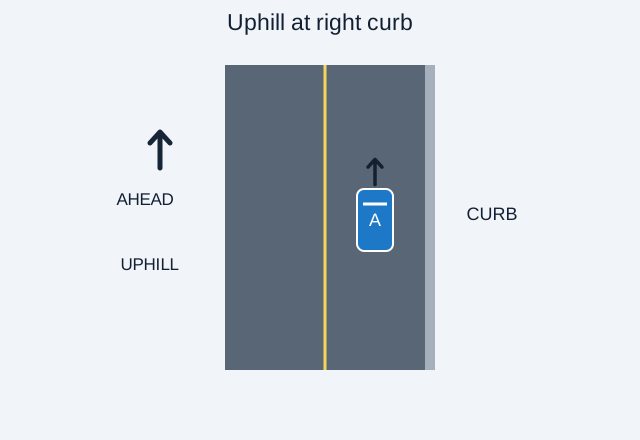
A is parked facing uphill beside a curb on its right. What should happen next?
- A. Turn the front wheels in toward the curb, the same as parking downhill, then set the parking brake.
- B. Release the parking brake.
- C. Angle the front tires out toward the street so they would roll back into the curb, then apply the parking brake.
- D. Leave the vehicle in neutral without a brake.
Show answer
Answer: C. Angle the front tires out toward the street so they would roll back into the curb, then apply the parking brake.
Facing uphill with a curb, point the tires toward the street. A small rollback then rests the rear of the front tire against the curb, which holds the car.
Question 20 · Permits and Test Preparation
A minor has studied every lesson but has not completed required supervised driving. What is still necessary?
- A. Complete the required supervised practice, including the required night practice.
- B. Nothing more, as long as the practice tests show you know the rules.
- C. Count only simulator time.
- D. Replace practice with mock exam scores.
Show answer
Answer: A. Complete the required supervised practice, including the required night practice.
Minor licensing requires supervised road practice with a night component; app study does not replace it.
Ready to test yourself?
Take a 20-question practice exam with the answers hidden. You get a score (aim for 16 of 20 or better) and an explanation for every answer. For the DMV’s own test format, see about the permit test.
More free practice and lessons
- Free California DMV practice test
- Road signs practice test
- Rules of the road practice test
- California DMV Practice Mock Exam 1 with answers
- California DMV Practice Mock Exam 3 with answers
- California DMV Practice Mock Exam 4 with answers
- California DMV Practice Mock Exam 5 with answers
- California DMV Practice Mock Exam 6 with answers
- California DMV Practice Mock Exam 7 with answers
- Signs and Signals
- Right of Way and Crossings
- Lanes and Turns
- Parking and Backing
- Sharing the Road
- Safe Driving and Hazards
- Alcohol, Drugs and Distraction
- Permits and Test Preparation
- About the California permit test
- 7-day study plan
- Permit test tips