By the ChowChow Labs editorial team · Updated November 6, 2026 · How we check our content
Who goes first at an all-way stop
Legal rule
The first vehicle to stop goes first. If two arrive together, the driver on the left lets the driver on the right go. Right of way is something you give, never something you take by force.
Example: You and a pickup to your right stop at the same moment. You wait for the pickup, then go.
Check the official wording in the California Driver Handbook.
Pedestrians and crosswalks
Legal rule
Most intersection corners count as crosswalks even without paint. Yield to anyone crossing there. People using a white cane or guide dog always get the right of way, and honking at them can be confusing and dangerous.
Example: A man with a guide dog steps off the curb as your light turns green. You stay stopped until he is safely across.
Check the official wording in the California Driver Handbook.
Railroad crossings
Legal rule
Never start across tracks unless your whole vehicle will fit on the far side. Lowered gates and flashing lights mean wait, even if you can't see a train. If you stall on the tracks, get everyone out and away, then call the number posted at the crossing.
Example: Traffic is backed up just past the tracks. You stop before the first rail and wait until a car-length of space opens beyond the second.
Check the official wording in the California Driver Handbook.
Roundabouts
Legal rule
Traffic in a roundabout circles counterclockwise. Slow down, yield to vehicles already circulating, enter to the right, and stay in your lane until your exit. Don't stop or pass inside.
Example: Your app says third exit. You enter to the right, pass two exits, signal right, and leave at the third.
Check the official wording in the California Driver Handbook.
Check yourself
Try these 6 questions from our free mock exams, then tap Show answer. For more, take the rules of the road practice test.
Question 1 · Right of Way and Crossings
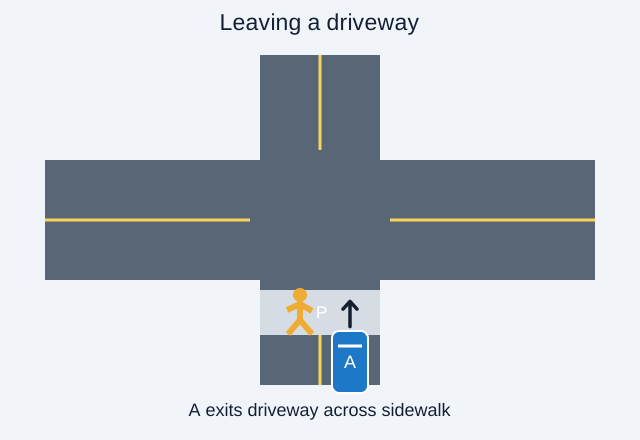
A is leaving a driveway. P is walking along the sidewalk directly across the driveway exit. What should happen next?
- A. P must stop and let A pull out.
- B. A yields to P, since P is already crossing the driveway.
- C. A blocks the sidewalk until P stops.
- D. A edges out slowly so P walks around the car.
Show answer
Answer: B. A yields to P, since P is already crossing the driveway.
A driver crossing a sidewalk must yield to pedestrians and then to roadway traffic.
Question 2 · Right of Way and Crossings
Your vehicle stalls on railroad tracks. What is the immediate priority?
- A. Try to restart the car or push it off the rails first, then get out if a train comes into view.
- B. Stand on the tracks to signal with your hands.
- C. Stay in the vehicle to protect belongings.
- D. Evacuate everyone well clear of the rails, then phone the railroad's posted emergency number or 911.
Show answer
Answer: D. Evacuate everyone well clear of the rails, then phone the railroad's posted emergency number or 911.
People matter more than the car. Move away from the tracks, angled toward the train's direction so debris won't hit you, then report the blocked crossing.
Question 3 · Right of Way and Crossings
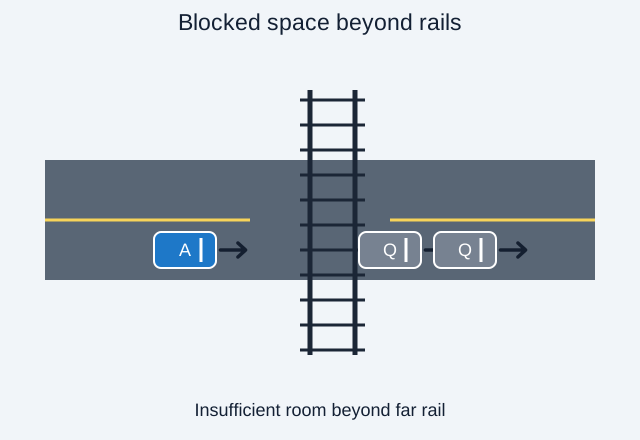
A approaches railroad tracks. Traffic beyond the tracks is stopped, leaving too little space for A beyond the far rail. What should happen next?
- A. A follows the vehicle ahead regardless of space.
- B. A pulls forward until only the front wheels are across, leaving the rest of the car on the tracks.
- C. A stays short of the crossing until the full length of the car will fit past the far rail.
- D. A queues on the tracks.
Show answer
Answer: C. A stays short of the crossing until the full length of the car will fit past the far rail.
Never start across railroad tracks unless there is room for your entire car beyond them. Getting stuck on the rails in a queue is how vehicles get hit by trains.
Question 4 · Right of Way and Crossings
A person using a white cane starts across the street in your path. What should you do?
- A. Yield and give the pedestrian time and space to cross safely.
- B. Honk to make the pedestrian hurry.
- C. Assume an electric vehicle is always heard.
- D. Drive slowly around the pedestrian, leaving a little room, so they aren't held up waiting for you.
Show answer
Answer: A. Yield and give the pedestrian time and space to cross safely.
Take particular care around a pedestrian using a white cane or guide dog.
Question 5 · Right of Way and Crossings
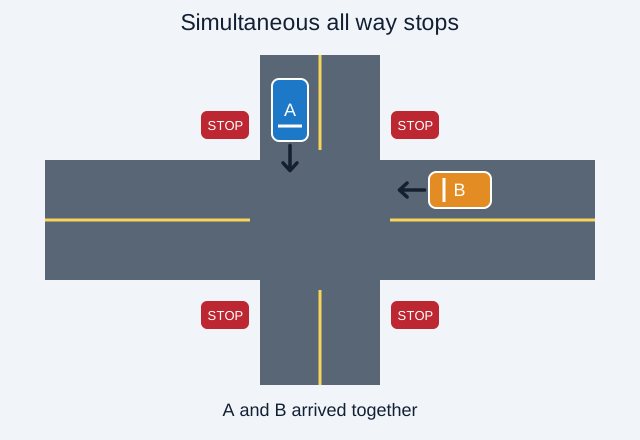
A and B stop simultaneously. A is southbound; B is westbound. Their paths conflict. B is to A’s left. What should happen next?
- A. A proceeds first, because B is to A's left.
- B. B goes first after a full stop.
- C. The larger vehicle always goes first.
- D. B goes first, because the driver on the left always has priority at an all-way stop.
Show answer
Answer: A. A proceeds first, because B is to A's left.
At simultaneous arrivals with conflicting paths, yield to the vehicle on your right. B yields to A.
Question 6 · Right of Way and Crossings
A school crossing guard tells you to stop while your traffic light is green. What should you do?
- A. Drive around the guard.
- B. Follow the crossing guard’s lawful directions.
- C. Go if the person behind honks.
- D. Ignore the guard whenever your signal is green.
Show answer
Answer: B. Follow the crossing guard’s lawful directions.
A crossing guard controls the crossing; a green signal does not justify disregarding the guard.
Next: Lanes and Turns. Center lines, the shared center turn lane, lane changes and turnouts.