By the ChowChow Labs editorial team · Updated November 6, 2026 · How we check our content
Passing bicyclists
Legal rule
When there is another lane available, change lanes to pass a cyclist if it's safe. Otherwise give at least three feet of space, and slow down or wait if you can't.
Example: A cyclist is riding around potholes on a narrow road with oncoming traffic. You stay behind until a safe gap appears.
Check the official wording in the California Driver Handbook.
Large trucks
Safety recommendation
Big rigs have large blind areas beside and behind them, need more room to stop, and swing wide to turn right. If you can't see the driver's mirrors, the driver can't see you.
Example: A truck signals right and drifts left first. You hang back instead of slipping into the gap on its right.
Check the official wording in the California Driver Handbook.
School buses
Legal rule
Amber lights on a school bus mean it's about to stop; slow down. Blinking red lights mean stop and stay stopped until they turn off. Traffic on the far side of a divided or multilane highway does not have to stop, but everyone on a two-lane road does.
Example: On a two-lane road a bus ahead flashes red. You stop and wait while kids cross.
Check the official wording in the California Driver Handbook.
Emergency vehicles and roadside crews
Legal rule
For a police car, fire truck or ambulance using siren and red lights, pull to the right and stop until it passes, but never stop inside an intersection. For stopped emergency, tow or Caltrans vehicles with flashing lights, move over a lane if you safely can, or slow down.
Example: A tow truck is working on the shoulder with amber lights flashing. You move one lane left.
Check the official wording in the California Driver Handbook.
Check yourself
Try these 6 questions from our free mock exams, then tap Show answer. For more, take the rules of the road practice test.
Question 1 · Sharing the Road
A bicyclist is ahead and an adjacent lane is available for a safe lane change. How should you plan the pass?
- A. Use the horn to force the rider off the road.
- B. Move into another available lane when required and safe; otherwise allow adequate clearance and slow as necessary.
- C. Pass within the same lane as long as the rider stays close to the curb, and keep up your speed so the pass is short.
- D. Pass despite unsafe clearance.
Show answer
Answer: B. Move into another available lane when required and safe; otherwise allow adequate clearance and slow as necessary.
A safe bicycle pass requires compliance with California lane-change and clearance rules; never force a close pass.
Question 2 · Sharing the Road
A road worker shows a STOP paddle at a single-lane work area. What should you do?
- A. Follow your navigation app's route instead.
- B. Obey the flagger’s directions and temporary traffic controls.
- C. Assume work-zone instructions apply only to trucks.
- D. Drive around a stop paddle if the road looks clear.
Show answer
Answer: B. Obey the flagger’s directions and temporary traffic controls.
A flagger may direct alternating traffic through a temporary lane; follow that control.
Question 3 · Sharing the Road
A stopped emergency vehicle has its warning lights on beside your lane. What should you do?
- A. Move over when safely possible and slow as required for the roadside hazard.
- B. Stop beside the emergency vehicle to watch.
- C. Use the shoulder to pass responders.
- D. Keep your speed and stay in your lane.
Show answer
Answer: A. Move over when safely possible and slow as required for the roadside hazard.
Roadside emergency activity requires space and reduced risk; comply with applicable move-over requirements.
Question 4 · Sharing the Road
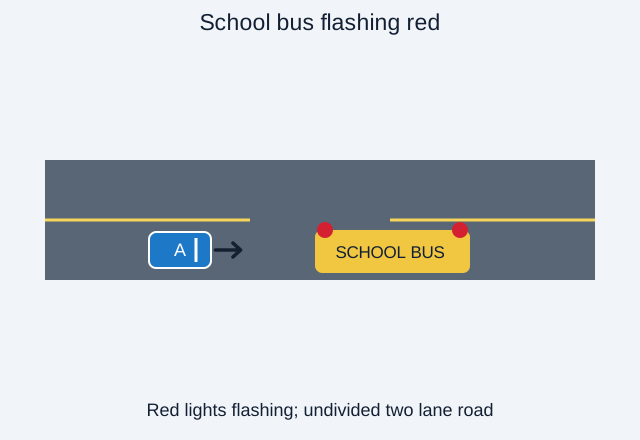
A follows a school bus stopped with red warning lights flashing on an undivided two-lane road. What should happen next?
- A. A may pass slowly, at walking speed.
- B. A passes after sounding the horn.
- C. A halts and does not move again until the bus's red lights go dark.
- D. A passes if no child is visible.
Show answer
Answer: C. A halts and does not move again until the bus's red lights go dark.
Blinking red lights on a school bus mean children may be crossing. On a two-lane road without a divider, traffic in both directions must stop and wait.
Question 5 · Sharing the Road
The amber lights on the school bus in front of you start blinking. What is your best move?
- A. Ignore the bus unless children are visible.
- B. Ease off the gas and get ready to halt behind the bus.
- C. Speed up and pass the bus before it stops, so you don't get held up behind it.
- D. Move into the opposing lane immediately.
Show answer
Answer: B. Ease off the gas and get ready to halt behind the bus.
Amber lights on a school bus are an early warning that it is about to halt and that children may soon be getting on or off. Reduce speed now so you can stop smoothly if the red lights come on.
Question 6 · Sharing the Road
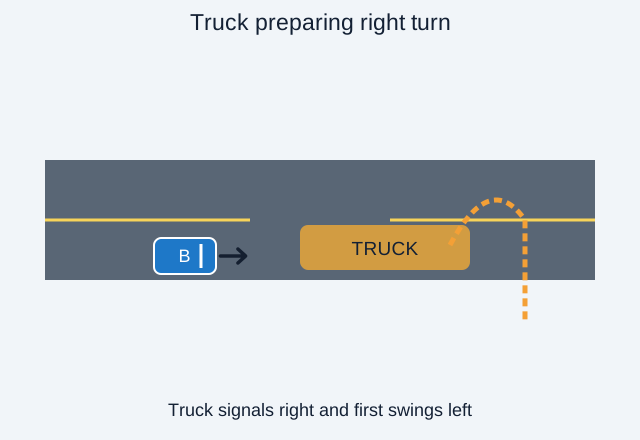
A truck indicates a right turn and swings left to make room. Car B is behind it near the right curb. What should happen next?
- A. B stays back rather than entering the space beside the turning truck.
- B. B squeezes between the truck and curb.
- C. B passes on the sidewalk.
- D. B moves up on the truck's right side.
Show answer
Answer: A. B stays back rather than entering the space beside the turning truck.
A large vehicle may need a wide approach. The inside space can close as its rear wheels follow a tighter path.
Next: Safe Driving and Hazards. The Basic Speed Law, following distance, lights and seat belts.