California DMV Practice Mock Exam 6
All 20 questions from Mock Exam 6, with answers and explanations.
A mixed exam: 5 sign questions, 5 road diagrams and 10 questions on the rules of the road, including right of way and crossings, safe driving and hazards and parking and backing.
These are the 20 questions from Mock Exam 6, original practice questions on signs and the rules of the road, checked against the California Driver Handbook. Read through them with Show answer, or take the exam online first with the answers hidden and see your score. No sign-in needed.
These are original practice questions, not actual DMV test questions. Each links to the California Driver Handbook so you can check the rule. Questions were last reviewed in November 2026; read how we write and check them.
Question 1 · Lanes and Turns
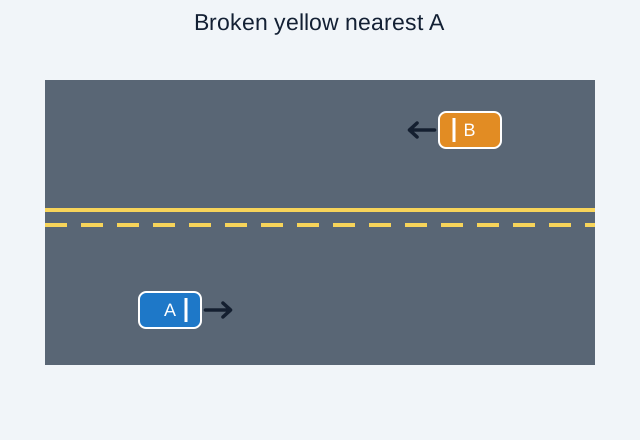
What does the broken yellow line on A's side of the center tell A?
- A. Passing is never allowed here.
- B. Passing is allowed from A's side when it is safe.
- C. Only drivers traveling in the opposite direction may pass, and only when the road is clear.
- D. It marks a bike lane.
Show answer
Answer: B. Passing is allowed from A's side when it is safe.
When the line nearest you is broken, you may pass, as long as the way is clear and it is otherwise legal.
Question 2 · Safe Driving and Hazards
Unless signs show otherwise, what is the top speed allowed on most California highways?
- A. 55 mph.
- B. 65 mph.
- C. 70 mph.
- D. 75 mph.
Show answer
Answer: B. 65 mph.
Most California highways top out at 65 mph unless a sign posts a different limit; some are posted at 70.
Question 3 · Sharing the Road
Orange cones narrow your lane ahead in a work zone. What's the safest approach?
- A. Speed up and pass the cones quickly before the lane narrows.
- B. Weave between the cones.
- C. Slow down early and merge before the cones.
- D. Follow the car ahead very closely.
Show answer
Answer: C. Slow down early and merge before the cones.
Merge early and smoothly. Late, fast merges cause crashes in work zones.
Question 4 · Right of Way and Crossings
Where is the emergency phone number for a railroad crossing usually posted?
- A. On a sign at or near the crossing.
- B. Painted on the road surface just before the tracks.
- C. Only on the DMV website.
- D. On the nearest stop sign.
Show answer
Answer: A. On a sign at or near the crossing.
Crossings usually have a sign with an emergency number and a crossing ID to give the railroad.
Question 5 · Safe Driving and Hazards
Who can be cited when a passenger under 16 isn't buckled up?
- A. The passenger.
- B. The child's parent only.
- C. Nobody; it's optional.
- D. The driver.
Show answer
Answer: D. The driver.
The driver is responsible for making sure passengers under 16 are properly restrained.
Question 6 · Signs and Signals
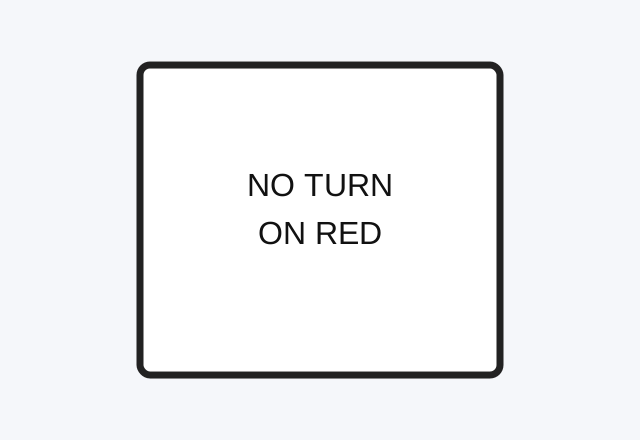
You are stopped at a red light under the pictured NO TURN ON RED sign. The light turns green. What may you do?
- A. Still not turn, since the sign forbids a right turn at this light in any phase.
- B. Turn only after another full stop.
- C. Turn after yielding to pedestrians and other traffic.
- D. Turn only if a green arrow appears.
Show answer
Answer: C. Turn after yielding to pedestrians and other traffic.
The sign only bans turning while the signal is red. Once it is green, you may turn when the way is clear.
Question 7 · Parking and Backing
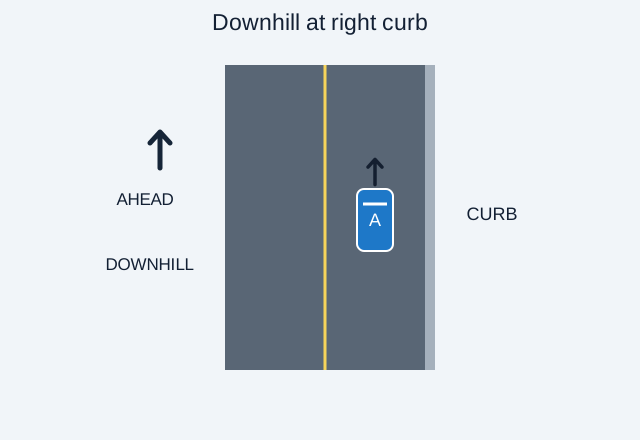
Why should A's front tires point into the curb when parked facing downhill?
- A. If the car starts to roll, the curb stops the front wheel.
- B. It makes leaving the space easier.
- C. It keeps the car farther from passing traffic and makes it easier to pull out later on.
- D. It is only needed for trucks.
Show answer
Answer: A. If the car starts to roll, the curb stops the front wheel.
The curb acts as a backstop. A wheel turned into it can't roll forward into the street.
Question 8 · Sharing the Road
Which way must bicyclists ride on the road?
- A. Facing oncoming traffic, so they can see cars coming toward them.
- B. Whichever direction they prefer.
- C. In the same direction as other traffic.
- D. Only on the sidewalk.
Show answer
Answer: C. In the same direction as other traffic.
Bicyclists ride with traffic, so watch for them on your right.
Question 9 · Parking and Backing
Why are young children at special risk behind a backing car?
- A. They always run toward moving cars.
- B. Backup cameras and sensors can't detect children.
- C. They can't hear car engines.
- D. They can be too short to see from the driver's seat.
Show answer
Answer: D. They can be too short to see from the driver's seat.
A small child can be completely hidden behind a car. Walk around and look before you back up.
Question 10 · Signs and Signals
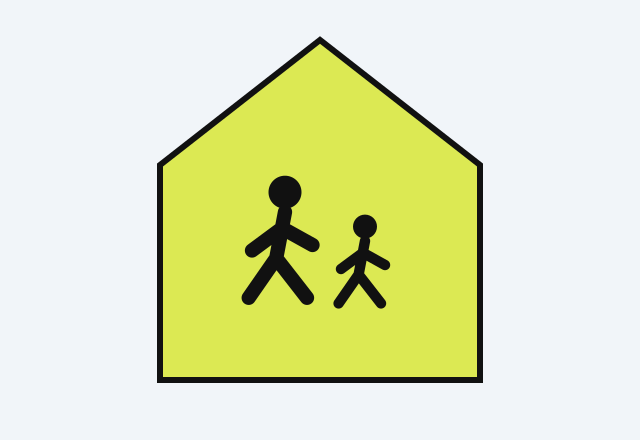
What shape and colors does the pictured SCHOOL sign use?
- A. A red octagon.
- B. An orange diamond, like other temporary warning signs.
- C. A blue rectangle.
- D. A five-sided shape in fluorescent yellow-green or yellow.
Show answer
Answer: D. A five-sided shape in fluorescent yellow-green or yellow.
The five-sided school sign is unique, so drivers can spot it from a distance.
Question 11 · Signs and Signals
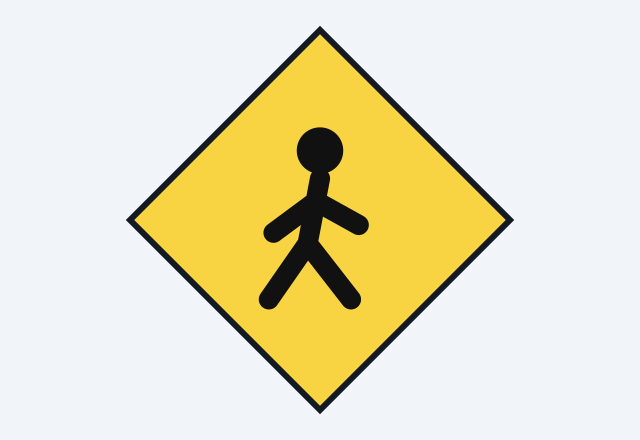
A person is waiting at the curb at the crossing marked by the pictured sign. What should you do?
- A. Ease off the gas and get ready to stop so they can cross.
- B. Speed up to pass before they step out.
- C. Honk to tell them to wait.
- D. Keep going at your speed, since they must wait for a gap in traffic.
Show answer
Answer: A. Ease off the gas and get ready to stop so they can cross.
Drivers must yield to people in a crosswalk. Be prepared to stop for someone who is about to cross.
Question 12 · Right of Way and Crossings
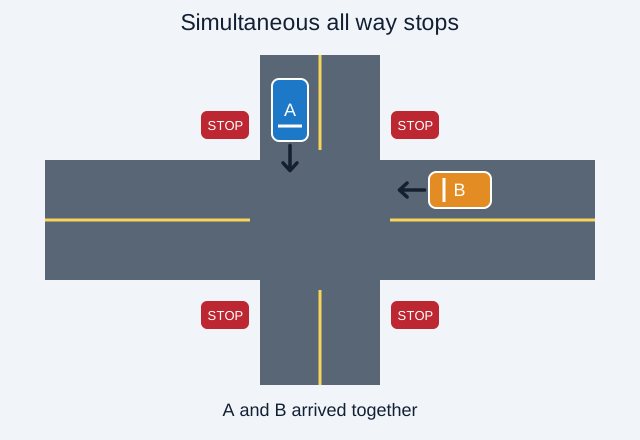
Both cars reach their stop lines at this four-way stop at the same moment: A heading south, B heading west. Which driver should let the other go first?
- A. B, because A is on B's right.
- B. A, because southbound traffic always leads.
- C. Whichever driver turns on a signal first.
- D. Neither; both wait for a third car to clear.
Show answer
Answer: A. B, because A is on B's right.
When two drivers stop at the same time, the one on the left gives way to the one on the right. From B's seat, A is on the right.
Question 13 · Safe Driving and Hazards
Within what distance of an oncoming vehicle must you dim your high beams?
- A. 100 feet.
- B. 1,000 feet.
- C. 50 feet.
- D. 500 feet.
Show answer
Answer: D. 500 feet.
Switch to low beams when an oncoming vehicle is within 500 feet.
Question 14 · Right of Way and Crossings
Why shouldn't you honk at a pedestrian using a white cane?
- A. It is only illegal after dark.
- B. It is illegal only after dark, when sound carries farther.
- C. They cannot hear car horns at all.
- D. It can startle or confuse them while they cross.
Show answer
Answer: D. It can startle or confuse them while they cross.
Blind pedestrians rely on sound. A horn can make them unsure whether to go or stop.
Question 15 · Right of Way and Crossings
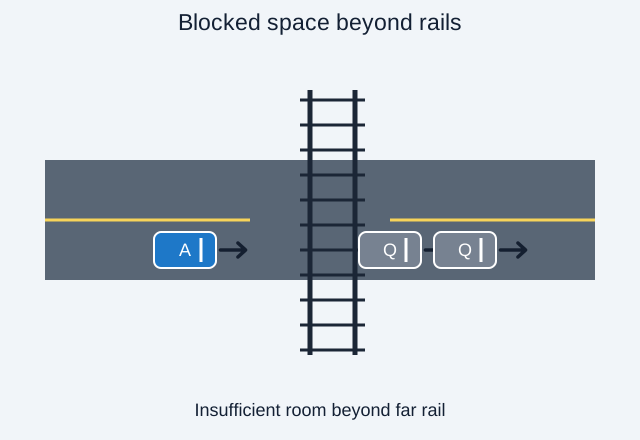
Traffic beyond the tracks is moving slowly. Why must A still wait before the crossing?
- A. Crossing rails at low speed can damage the tires and suspension, so it is better to cross in one go.
- B. Trains always stop for traffic.
- C. A could end up stopped on the tracks when a train arrives.
- D. Waiting saves fuel.
Show answer
Answer: C. A could end up stopped on the tracks when a train arrives.
A train can't stop quickly. Never be on the tracks unless you can get all the way across.
Question 16 · Right of Way and Crossings
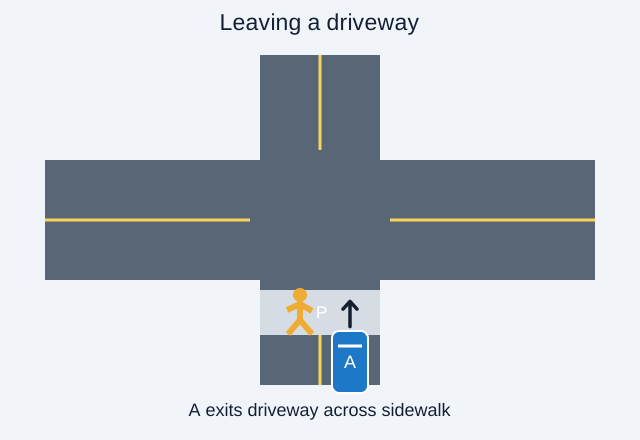
Where should A first stop when leaving the driveway?
- A. At the edge of the street lane, where A has a better view of traffic both ways.
- B. Before the sidewalk, to check for people walking.
- C. Across the sidewalk.
- D. A doesn't need to stop at all.
Show answer
Answer: B. Before the sidewalk, to check for people walking.
Stopping before the sidewalk gives you a clear look for pedestrians before crossing their path.
Question 17 · Signs and Signals
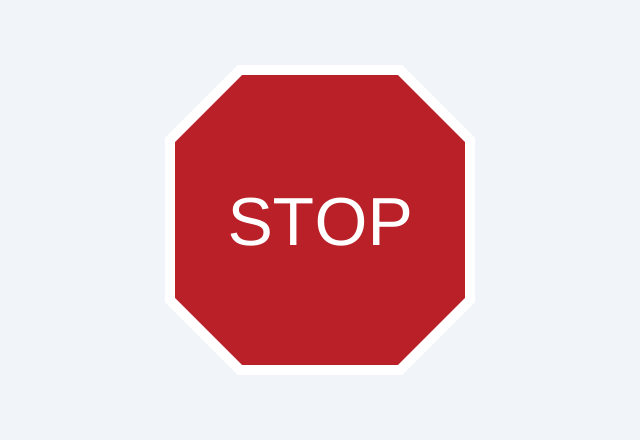
You stop at the pictured STOP sign, but bushes block your view of the cross street. What should you do next?
- A. Go ahead without stopping again, as you have already made your full stop.
- B. Turn on your hazard lights and pull straight out.
- C. Back up and choose another street.
- D. Creep forward slowly until you can see, ready to stop again.
Show answer
Answer: D. Creep forward slowly until you can see, ready to stop again.
Stopping at the line meets the sign's requirement, but you still need a clear view. Edge forward carefully until you can see cross traffic.
Question 18 · Signs and Signals
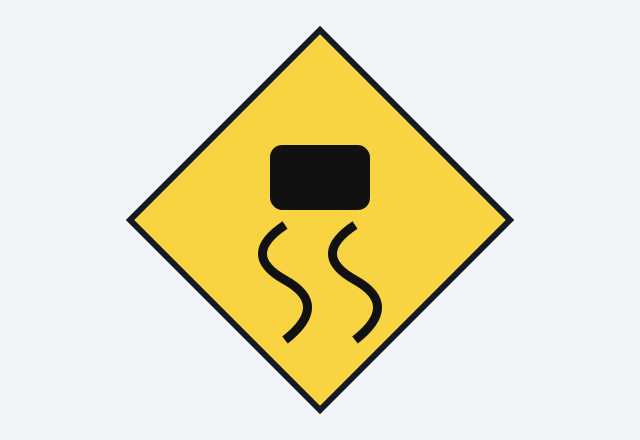
When is the road at the pictured SLIPPERY WHEN WET sign most slippery?
- A. After hours of heavy rain, once water has soaked into the road.
- B. During the first few minutes of rain, when oil rises to the surface.
- C. Only when it is freezing.
- D. Late at night, when the air is coolest.
Show answer
Answer: B. During the first few minutes of rain, when oil rises to the surface.
Oil and dust mix with the first rain to make a slick film. Take extra care when rain begins.
Question 19 · Signs and Signals
When may you turn left on a red light?
- A. From any street onto any other street, as long as you stop and no one is coming.
- B. Never, under any circumstances.
- C. When you're on a one-way road turning left into another one-way road, after stopping.
- D. Only when an officer waves you forward.
Show answer
Answer: C. When you're on a one-way road turning left into another one-way road, after stopping.
A left on red is allowed only from a one-way street onto another one-way street heading left, after a full stop and yielding, unless a sign forbids it.
Question 20 · Permits and Test Preparation
Who certifies that a minor has completed the required supervised driving hours?
- A. The DMV examiner, who checks the log on the day of the driving test.
- B. The licensed adult, 25 or older, who supervised the practice.
- C. Any adult friend over 18.
- D. The minor, by signing alone.
Show answer
Answer: B. The licensed adult, 25 or older, who supervised the practice.
The supervising adult, who must be 25 or older and hold a valid California license, certifies the practice hours.
Ready to test yourself?
Take a 20-question practice exam with the answers hidden. You get a score (aim for 16 of 20 or better) and an explanation for every answer. For the DMV’s own test format, see about the permit test.
More free practice and lessons
- Free California DMV practice test
- Road signs practice test
- Rules of the road practice test
- California DMV Practice Mock Exam 1 with answers
- California DMV Practice Mock Exam 2 with answers
- California DMV Practice Mock Exam 3 with answers
- California DMV Practice Mock Exam 4 with answers
- California DMV Practice Mock Exam 5 with answers
- California DMV Practice Mock Exam 7 with answers
- Signs and Signals
- Right of Way and Crossings
- Lanes and Turns
- Parking and Backing
- Sharing the Road
- Safe Driving and Hazards
- Alcohol, Drugs and Distraction
- Permits and Test Preparation
- About the California permit test
- 7-day study plan
- Permit test tips