California DMV Practice Mock Exam 5
All 20 questions from Mock Exam 5, with answers and explanations.
A mixed exam: 5 sign questions, 5 road diagrams and 10 questions on the rules of the road, including lanes and turns, right of way and crossings and sharing the road.
These are the 20 questions from Mock Exam 5, original practice questions on signs and the rules of the road, checked against the California Driver Handbook. Read through them with Show answer, or take the exam online first with the answers hidden and see your score. No sign-in needed.
These are original practice questions, not actual DMV test questions. Each links to the California Driver Handbook so you can check the rule. Questions were last reviewed in November 2026; read how we write and check them.
Question 1 · Lanes and Turns
Your slow car is holding up a line of six vehicles on a twisty two-lane road with no safe place to pass. A turnout is coming up. What should you do?
- A. Use the turnout so the line can get by.
- B. Speed up beyond what's safe to please them.
- C. Straddle the center line to stop anyone passing.
- D. Stop suddenly in the lane to let them go.
Show answer
Answer: A. Use the turnout so the line can get by.
When you're slow, can't safely be passed, and five or more vehicles are lined up behind you, pull into a turnout or passing lane.
Question 2 · Permits and Test Preparation
You are about to start the official DMV knowledge test. When may you use this practice app?
- A. Use a hidden handbook page.
- B. Keep this app open during the official test, as long as it's only for reference.
- C. Ask another person for answers while testing.
- D. Use study aids before the exam, not during the official knowledge test.
Show answer
Answer: D. Use study aids before the exam, not during the official knowledge test.
The official knowledge test prohibits testing aids; app practice should remain separate from the test itself.
Question 3 · Signs and Signals
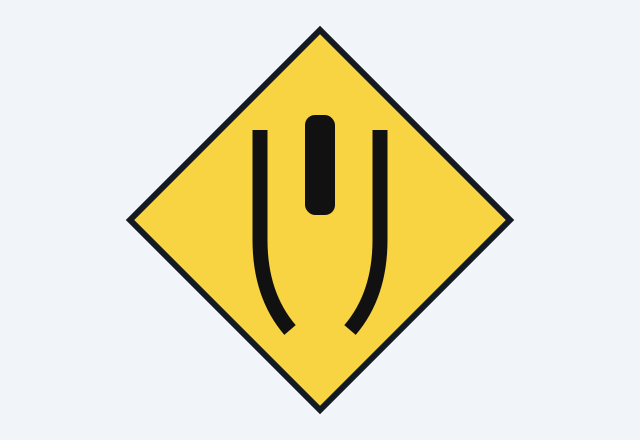
The illustrated DIVIDED HIGHWAY ENDS sign faces your lane. What is the appropriate response?
- A. Move into the oncoming lane.
- B. Expect the median to become wider and the lanes to spread farther apart.
- C. Prepare for opposing traffic without a separating median ahead.
- D. Treat both lanes as one-way.
Show answer
Answer: C. Prepare for opposing traffic without a separating median ahead.
The physical separation ends; watch lane markings and opposing vehicles.
Question 4 · Signs and Signals
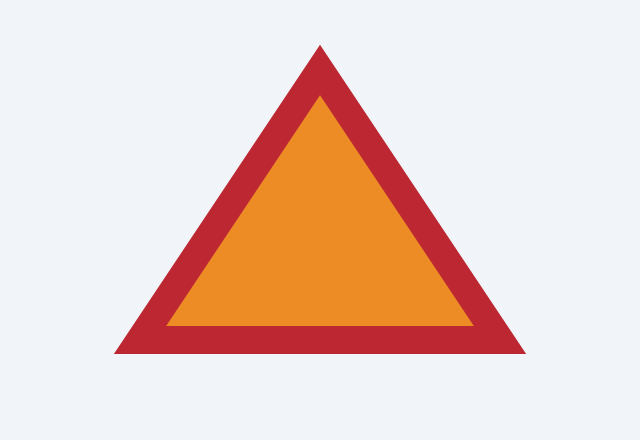
The illustrated SLOW VEHICLE sign faces your lane. What is the appropriate response?
- A. Expect a slow-moving vehicle and approach with a safe speed difference.
- B. Pass immediately on any curve.
- C. Follow closely so the slow driver knows to pull over and let you pass.
- D. Assume the vehicle can accelerate like a car.
Show answer
Answer: A. Expect a slow-moving vehicle and approach with a safe speed difference.
The orange triangle with a red border identifies a slow-moving vehicle. Plan any pass only where legal and safe.
Question 5 · Lanes and Turns
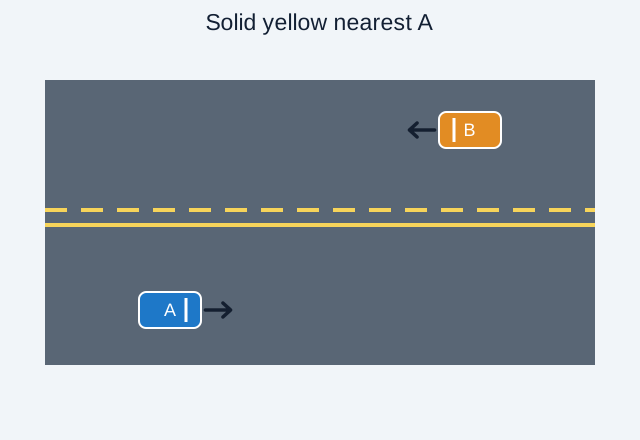
A’s side of the centerline is solid yellow; the opposing side is broken yellow. A wants to pass a moving car. What should happen next?
- A. A passes because the opposite side is broken.
- B. A passes by sounding the horn.
- C. A does not cross the solid line to pass.
- D. A passes if the car is small.
Show answer
Answer: C. A does not cross the solid line to pass.
For passing, the line nearest your lane matters. A solid yellow line on your side prohibits this pass.
Question 6 · Lanes and Turns
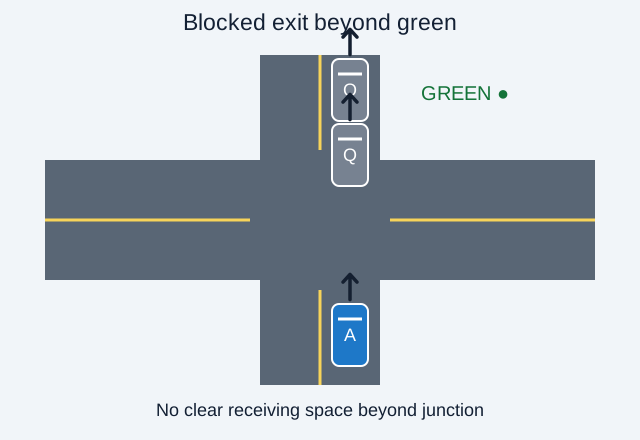
A has a green light. A queue beyond the intersection leaves no room for A to clear it. What should happen next?
- A. A holds behind the limit line until there is space for the whole car on the far side.
- B. A uses the opposing lane to escape.
- C. A pulls forward into the intersection so the cars behind A can move up, then waits there.
- D. A enters and blocks cross traffic.
Show answer
Answer: A. A holds behind the limit line until there is space for the whole car on the far side.
A green light gives permission to go, not permission to block. Entering when you can't get all the way across can trap you in cross traffic's path when the light changes.
Question 7 · Lanes and Turns
The next lane is moving at your speed but a car occupies the space beside you. How should you change lanes?
- A. Signal and start moving over so the other driver knows to make room for you.
- B. Wait for a suitable gap, signal, check mirrors and blind spots, and move smoothly.
- C. Force a gap by edging into another car.
- D. Change lanes without checking your mirrors.
Show answer
Answer: B. Wait for a suitable gap, signal, check mirrors and blind spots, and move smoothly.
A safe lane change needs adequate space and direct checks; speed matching alone is insufficient.
Question 8 · Right of Way and Crossings
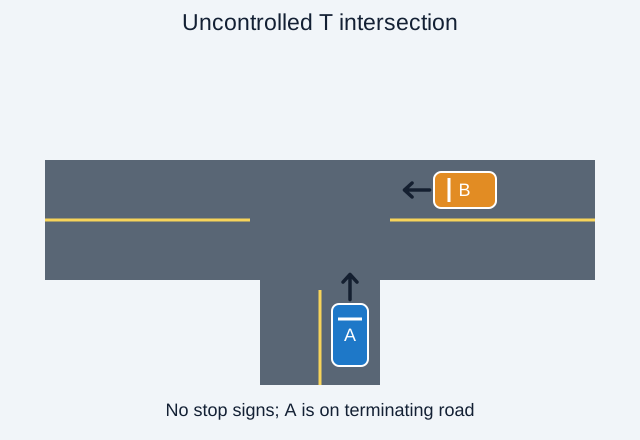
A approaches the end of a terminating road with no signs. B is already approaching on the continuing road. Their paths conflict. What should happen next?
- A. B yields because A is on a smaller road.
- B. A yields to B, because B is on the continuing road.
- C. A always goes first when turning.
- D. Both enter at the same time.
Show answer
Answer: B. A yields to B, because B is on the continuing road.
At an uncontrolled T intersection, traffic on the terminating road yields to traffic on the continuing road.
Question 9 · Alcohol, Drugs and Distraction
A long message arrives while you are driving. How should you handle it?
- A. Pull over safely before handling a distracting task.
- B. Hold the phone below the window.
- C. Let the car ahead guide you while typing.
- D. Read it quickly while traffic is moving slowly, then put the phone down.
Show answer
Answer: A. Pull over safely before handling a distracting task.
A phone task can take attention and hands away from driving. Stop safely before interacting when the task would distract you.
Question 10 · Signs and Signals
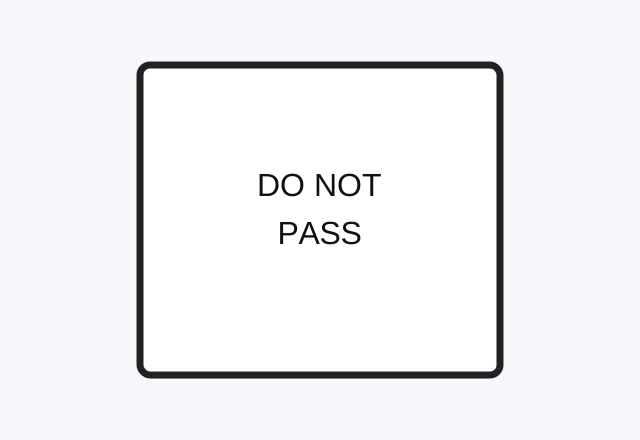
The illustrated DO NOT PASS sign faces your lane. What is the appropriate response?
- A. Wait until passing is permitted and safe.
- B. Use the shoulder to overtake.
- C. Pass only motorcycles.
- D. Pass quickly at a higher speed so you spend as little time as possible in the other lane.
Show answer
Answer: A. Wait until passing is permitted and safe.
This regulatory message prohibits passing in the controlled segment.
Question 11 · Right of Way and Crossings
A railway gate starts lowering as you approach. What should you do?
- A. Assume a first train means no second train.
- B. Stop before the crossing and wait until it is safe and legally open.
- C. Cross quickly before the gate comes all the way down.
- D. Drive around a lowered gate.
Show answer
Answer: B. Stop before the crossing and wait until it is safe and legally open.
Active rail warnings and gates require stopping. Multiple tracks may have additional trains.
Question 12 · Safe Driving and Hazards
Thick fog reduces your view on a rural road. Which lighting and speed choice is appropriate?
- A. Drive with lights off.
- B. Follow the car ahead closely for guidance.
- C. Switch to high beams so you can see farther, and keep a normal speed.
- D. Switch to the dipped (low) beams and drive slowly enough to stop within what you can see.
Show answer
Answer: D. Switch to the dipped (low) beams and drive slowly enough to stop within what you can see.
Bright beams bounce off fog droplets and blind you with glare. Dipped lights and a lower speed give you the best chance to see and stop in time.
Question 13 · Signs and Signals
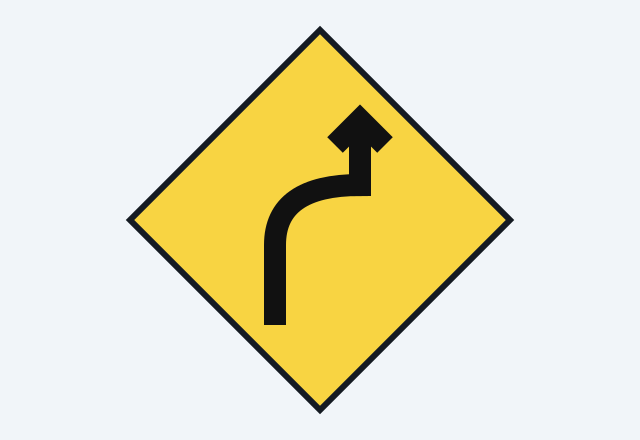
The illustrated CURVE AHEAD sign faces your lane. What is the appropriate response?
- A. Cross the centerline for a wider path.
- B. Adjust speed before entering the curve.
- C. Accelerate into the bend.
- D. Brake sharply halfway through every curve.
Show answer
Answer: B. Adjust speed before entering the curve.
Entering at a suitable speed helps maintain control while staying in your lane.
Question 14 · Right of Way and Crossings
A pedestrian is crossing at an intersection with no painted crosswalk. What should you remember?
- A. Treat all unpainted crossings as prohibited.
- B. Yield only where crosswalk lines are painted; at an unmarked corner, the walker must wait for a gap in traffic.
- C. Treat the corner as a legal crossing even without stripes, and yield to the walker.
- D. Assume pedestrians never have priority at intersections.
Show answer
Answer: C. Treat the corner as a legal crossing even without stripes, and yield to the walker.
At most intersections the crossing exists by law even when no paint is visible, so a person walking there has the same priority as in a striped crosswalk.
Question 15 · Lanes and Turns
You plan to travel 600 feet in a shared center left-turn lane before your driveway. What should you do instead?
- A. Drive in the center lane for the full distance, since it keeps you out of the way of through traffic.
- B. Move into the shared middle lane just before your turn, travelling no more than 200 feet in it.
- C. Treat it as a permanent through lane.
- D. Use it as a long passing lane.
Show answer
Answer: B. Move into the shared middle lane just before your turn, travelling no more than 200 feet in it.
The two-way center lane is only for setting up a left turn (or a U-turn where allowed). California caps travel in it at 200 feet, so it can't be used as a bypass or passing lane.
Question 16 · Lanes and Turns
Your freeway exit appears after you have passed the lane split. What is the best response?
- A. Keep going and fix the route at the next point where turning around is legal and safe.
- B. Steer across the lanes at the last moment if the gap looks big enough.
- C. Stop in the travel lane to reconsider.
- D. Reverse along the freeway shoulder.
Show answer
Answer: A. Keep going and fix the route at the next point where turning around is legal and safe.
Backing up, cutting across lanes or stopping in traffic to rescue a missed turn is far more dangerous than a few extra minutes of driving.
Question 17 · Sharing the Road
A motorcycle is ahead in your lane. How should you pass it when passing becomes legal and safe?
- A. Assume its small size eliminates blind spots.
- B. Give the motorcycle room and do not squeeze past it within its lane.
- C. Force it onto the shoulder.
- D. Share its lane and pass closely.
Show answer
Answer: B. Give the motorcycle room and do not squeeze past it within its lane.
A motorcycle needs usable lane space and may need to avoid road hazards.
Question 18 · Sharing the Road
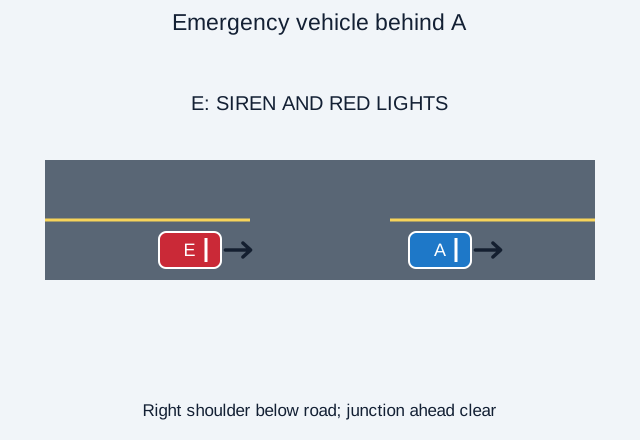
A is traveling on a clear road. E, an ambulance with its siren wailing and red lights flashing, closes in from behind; no intersection is involved. What should happen next?
- A. A stops right where it is, in the middle of its lane, and waits for E to go around.
- B. A accelerates to race E.
- C. A follows E through traffic.
- D. A pulls over to the right edge and stops until E has gone by.
Show answer
Answer: D. A pulls over to the right edge and stops until E has gone by.
When an emergency vehicle is running with siren and red lights, steer to the right side and come to a stop until it passes. If you are in an intersection, clear it first; never stop inside one.
Question 19 · Lanes and Turns
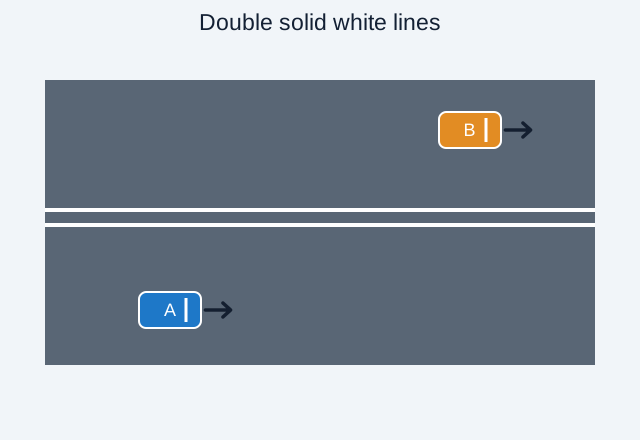
A and B travel in the same direction, separated by double solid white lines. A wants to move into B’s lane. What should happen next?
- A. Signal and move over carefully.
- B. Cross if the lane seems empty.
- C. Wait for a legal opening instead of crossing the double white lines.
- D. Use a turn signal to override the barrier.
Show answer
Answer: C. Wait for a legal opening instead of crossing the double white lines.
Double solid white lines form a lane barrier that drivers must not cross.
Question 20 · Signs and Signals
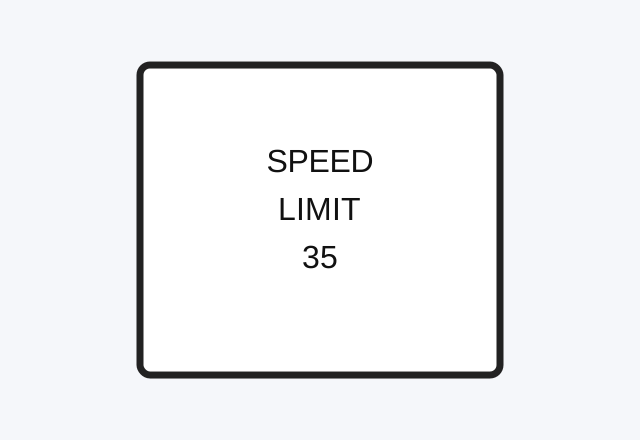
The illustrated SPEED LIMIT 35 sign faces your lane. What is the appropriate response?
- A. Drive at 35 mph whatever the visibility.
- B. Drive at least 35 mph.
- C. Treat 35 mph as the posted maximum and slow further when conditions require.
- D. Treat 35 as a suggested minimum.
Show answer
Answer: C. Treat 35 mph as the posted maximum and slow further when conditions require.
A posted limit does not make that speed safe in poor conditions; the basic speed law still applies.
Ready to test yourself?
Take a 20-question practice exam with the answers hidden. You get a score (aim for 16 of 20 or better) and an explanation for every answer. For the DMV’s own test format, see about the permit test.
More free practice and lessons
- Free California DMV practice test
- Road signs practice test
- Rules of the road practice test
- California DMV Practice Mock Exam 1 with answers
- California DMV Practice Mock Exam 2 with answers
- California DMV Practice Mock Exam 3 with answers
- California DMV Practice Mock Exam 4 with answers
- California DMV Practice Mock Exam 6 with answers
- California DMV Practice Mock Exam 7 with answers
- Signs and Signals
- Right of Way and Crossings
- Lanes and Turns
- Parking and Backing
- Sharing the Road
- Safe Driving and Hazards
- Alcohol, Drugs and Distraction
- Permits and Test Preparation
- About the California permit test
- 7-day study plan
- Permit test tips