By the ChowChow Labs editorial team · Updated November 6, 2026 · How we check our content
What the center lines tell you
Legal rule
Yellow lines separate opposing traffic; white lines separate traffic moving the same way. A broken line on your side means you may pass when it's safe. A solid line on your side means don't. A wide median outlined by double yellow lines on both edges acts as a barrier.
Example: Your side shows a broken yellow line and the road ahead is clear for a long way, so passing a tractor is allowed.
Check the official wording in the California Driver Handbook.
The shared center turn lane
Legal rule
The middle lane on some streets is for drivers from either direction getting ready to turn left. Enter it shortly before your turn; California limits travel in it to 200 feet. It is not a passing or merging lane.
Example: Your driveway is a block ahead. You wait until you are close, then move into the center lane and turn.
Check the official wording in the California Driver Handbook.
Changing lanes safely
Safety recommendation
Signal, check the mirrors, and turn your head to see the blind spot. Move only when there is a gap you won't squeeze anyone out of, and move smoothly rather than all at once.
Example: Your mirror is clear, but a quick head check shows a motorcycle beside your rear door. You wait.
Check the official wording in the California Driver Handbook.
Slow vehicles and turnouts
Legal rule
On a two-lane road where passing isn't safe, a slow driver with five or more vehicles stacked up behind must use a turnout or safe pullout to let them by.
Example: Towing a trailer up a mountain road, you notice six cars behind you and pull into the next turnout.
Check the official wording in the California Driver Handbook.
Check yourself
Try these 6 questions from our free mock exams, then tap Show answer. For more, take the rules of the road practice test.
Question 1 · Lanes and Turns
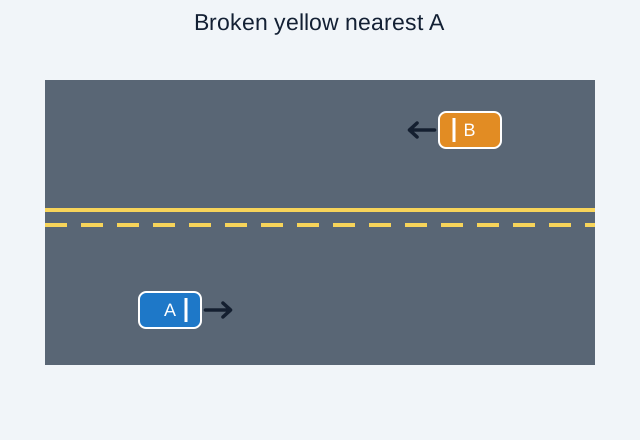
A follows a slower vehicle on a two-way road. The centerline is broken on A’s side and solid on the opposite side. The view ahead is clear. What should happen next?
- A. Pass without checking oncoming traffic.
- B. Use the oncoming shoulder.
- C. Pass only if it is otherwise legal and there is enough safe space.
- D. Stay behind the slow car.
Show answer
Answer: C. Pass only if it is otherwise legal and there is enough safe space.
A broken line on your side permits a pass only when the maneuver is also safe and legal.
Question 2 · Lanes and Turns
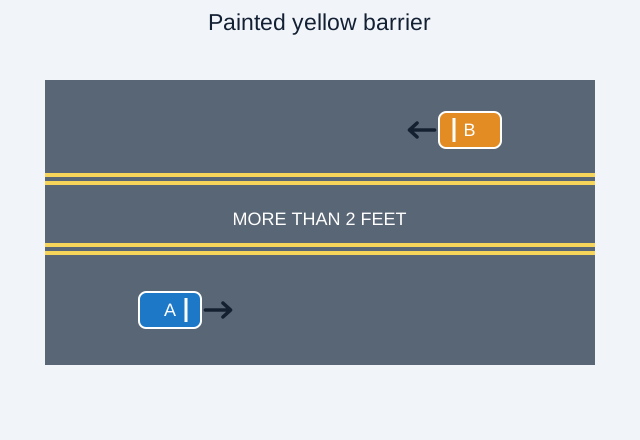
A wants to turn left across a wide painted median. Each edge of the median is a pair of solid yellow lines, and the edges are more than 2 feet apart. No gap is marked. What should happen next?
- A. Cross whenever no car is visible.
- B. Do not cross the painted barrier.
- C. Cross to save distance.
- D. Treat it as an ordinary shared turn lane.
Show answer
Answer: B. Do not cross the painted barrier.
A median outlined this way works like a concrete divider. Don't drive on it or turn across it; use a marked opening further along.
Question 3 · Lanes and Turns
Your freeway exit has a separate deceleration lane. How should you plan to slow?
- A. Cross solid barriers to reach the ramp.
- B. Enter the exit lane safely and reduce speed in the deceleration lane as appropriate.
- C. Stop at the gore point.
- D. Slow down in the through lane first, then move into the exit lane at the ramp speed.
Show answer
Answer: B. Enter the exit lane safely and reduce speed in the deceleration lane as appropriate.
Plan the exit early and use the designated lane to slow without creating unnecessary conflict in through traffic.
Question 4 · Lanes and Turns
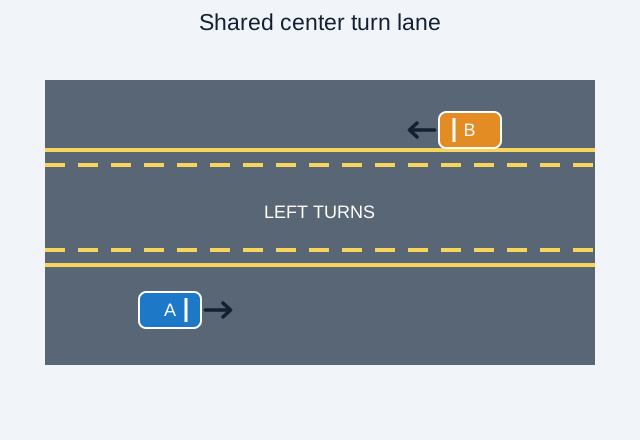
A needs a left turn ahead. The middle lane is marked for left turns by traffic from both directions. What should happen next?
- A. Use the middle lane to prepare for the left turn, not for passing.
- B. Treat it as a normal through lane.
- C. Drive there continuously for several blocks.
- D. Use the middle lane to pass a slow line of traffic, then move back before the turn.
Show answer
Answer: A. Use the middle lane to prepare for the left turn, not for passing.
A shared center turn lane serves turning maneuvers and is not a through or passing lane.
Question 5 · Lanes and Turns
A hill blocks your view of opposing traffic on a two-way road. Should you begin a pass?
- A. Pass on a blind curve by sounding the horn.
- B. Yes, begin the pass if the vehicle ahead is very slow, and finish it quickly before the top of the hill.
- C. Rely on the lead driver to warn of oncoming traffic.
- D. Wait until the view and available space make the entire pass legal and safe.
Show answer
Answer: D. Wait until the view and available space make the entire pass legal and safe.
Permission from markings alone does not ensure enough clear distance for an overtaking maneuver.
Question 6 · Lanes and Turns
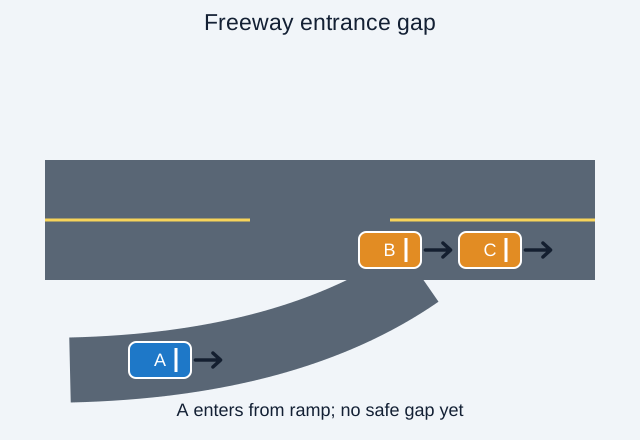
A is on an entrance ramp. B and C are in the freeway lane, with no safe gap currently available. What should happen next?
- A. A signals and merges at the end of the ramp.
- B. A forces B and C to brake sharply.
- C. A enters regardless of the gap.
- D. A adjusts speed on the ramp and merges only into a safe gap.
Show answer
Answer: D. A adjusts speed on the ramp and merges only into a safe gap.
Entering traffic must yield; a signal communicates intent but does not create a right to merge.
Next: Parking and Backing. Hill parking, curb colors, backing up and opening doors.