California Road Signs Practice Test
Signs, signals and lights, with answers.
Traffic signs are a big part of the California knowledge test. These free questions cover regulatory and warning signs, traffic lights and arrows, and what to do when signals go dark. Look at each sign, pick your answer, then tap Show answer to see the explanation. New to signs? Start with our signs and signals lesson.
These are original practice questions, not actual DMV test questions. Each links to the California Driver Handbook so you can check the rule. Questions were last reviewed in November 2026; read how we write and check them.
Question 1 · Signs and Signals
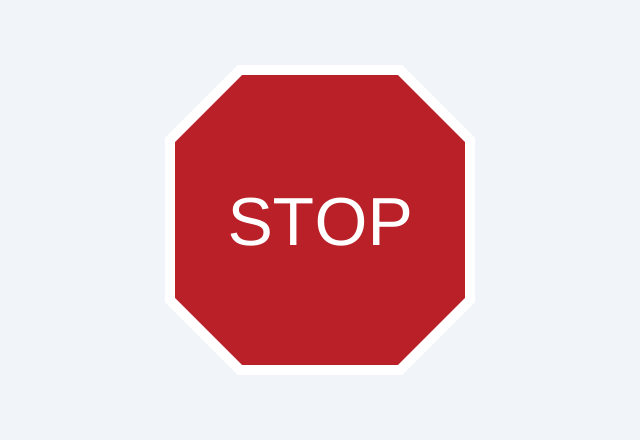
The illustrated STOP sign faces your lane. What is the appropriate response?
- A. Slow down and roll through carefully if no other vehicles or people are in sight.
- B. Stop only when another car arrives.
- C. Come to a complete stop, then yield before proceeding.
- D. Accelerate to clear the junction.
Show answer
Answer: C. Come to a complete stop, then yield before proceeding.
A stop sign requires a full stop. Afterward, check for conflicts and yield before entering.
Question 2 · Signs and Signals
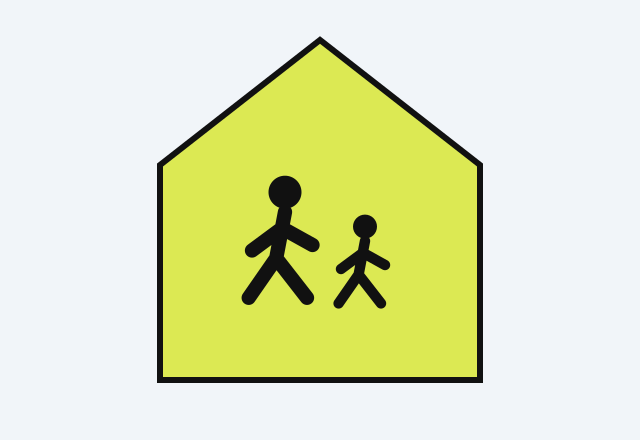
The illustrated SCHOOL sign faces your lane. What is the appropriate response?
- A. Expect children to wait on the curb, and keep moving at the normal speed limit.
- B. Sound the horn instead of slowing.
- C. Look only for cars.
- D. Watch for children and obey crossing guards and posted controls.
Show answer
Answer: D. Watch for children and obey crossing guards and posted controls.
The school warning calls attention to children; posted speed and crossing instructions still govern.
Question 3 · Signs and Signals
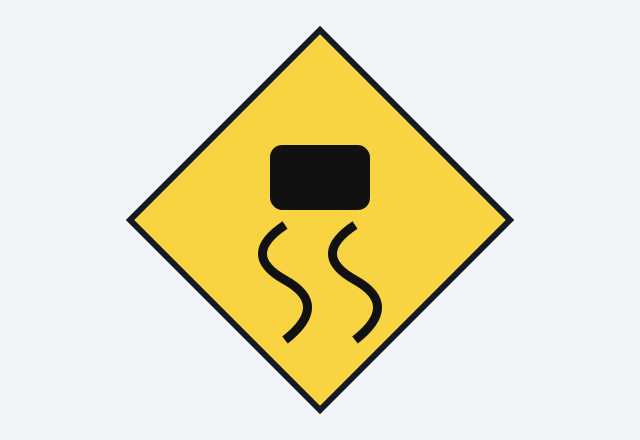
The illustrated SLIPPERY WHEN WET sign faces your lane. What is the appropriate response?
- A. Follow in the tire tracks of the car ahead at your usual distance.
- B. Assume normal traction in rain.
- C. Brake hard to test grip.
- D. Allow extra space and avoid abrupt steering or braking when wet.
Show answer
Answer: D. Allow extra space and avoid abrupt steering or braking when wet.
Water can reduce available grip, so smooth control and additional space are appropriate.
Question 4 · Signs and Signals
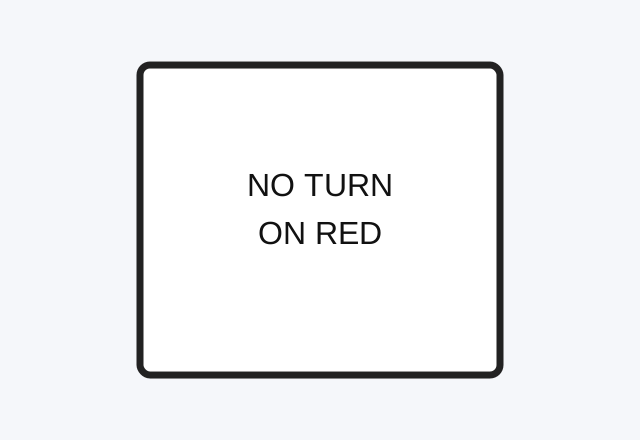
The illustrated NO TURN ON RED sign faces your lane. What is the appropriate response?
- A. Turn whenever no pedestrians are present.
- B. Turn if no cars are coming from the left.
- C. Wait for a signal that permits the turn.
- D. Turn after pausing briefly.
Show answer
Answer: C. Wait for a signal that permits the turn.
A posted prohibition prevents a red-light turn even after stopping.
Question 5 · Signs and Signals
You approach a circular red light to turn right. No sign prohibits the turn. What must happen before you turn?
- A. Slow down, check for cross traffic and turn without stopping.
- B. Treat every red light as a yield sign.
- C. Turn without checking the crosswalk.
- D. Stop fully, obey any turn prohibition, and yield before a permitted right turn.
Show answer
Answer: D. Stop fully, obey any turn prohibition, and yield before a permitted right turn.
A permitted right turn at a circular red still requires a full stop and a safe path; signs can prohibit it.
Question 6 · Signs and Signals
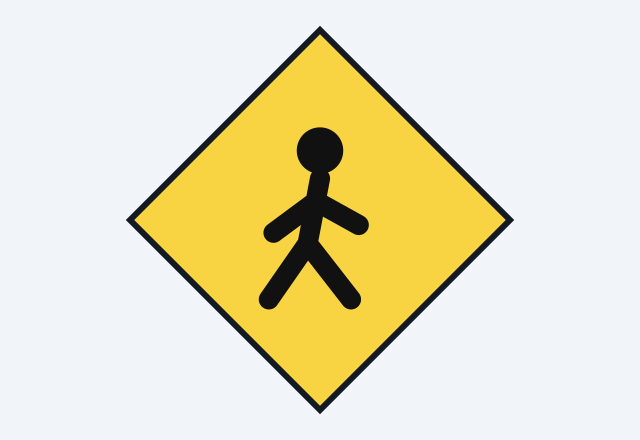
The illustrated PEDESTRIAN CROSSING sign faces your lane. What is the appropriate response?
- A. Expect people to cross only at the signal ahead, not at this sign.
- B. Scan for people crossing and yield when required.
- C. Accelerate before anyone steps out.
- D. Yield only when a horn sounds.
Show answer
Answer: B. Scan for people crossing and yield when required.
The warning calls attention to people crossing; be prepared to yield safely.
Question 7 · Signs and Signals
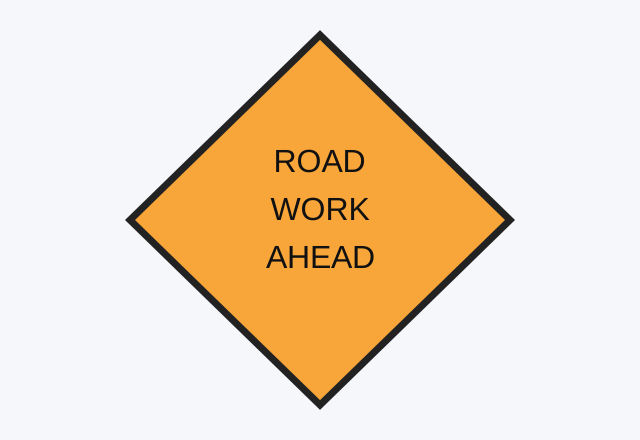
The illustrated ROAD WORK AHEAD sign faces your lane. What is the appropriate response?
- A. Reduce risk by slowing as needed and following temporary controls.
- B. Maintain speed past all workers.
- C. Ignore flaggers when your traffic light is green.
- D. Follow only permanent lane markings.
Show answer
Answer: A. Reduce risk by slowing as needed and following temporary controls.
Work zones can change lanes and hazards. Follow applicable temporary traffic control.
Question 8 · Signs and Signals
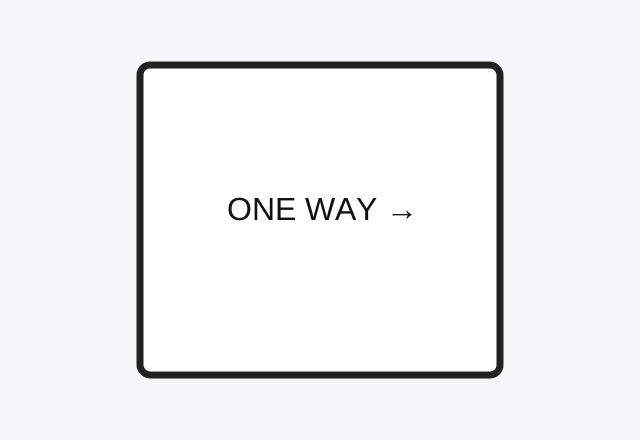
The illustrated ONE WAY → sign faces your lane. What is the appropriate response?
- A. Treat it as a passing instruction.
- B. Follow the arrow only during rush hour.
- C. Travel only in the direction indicated by the arrow.
- D. Use either direction when the street is empty, keeping to the right side.
Show answer
Answer: C. Travel only in the direction indicated by the arrow.
A one-way sign defines the permitted traffic direction.
Question 9 · Signs and Signals
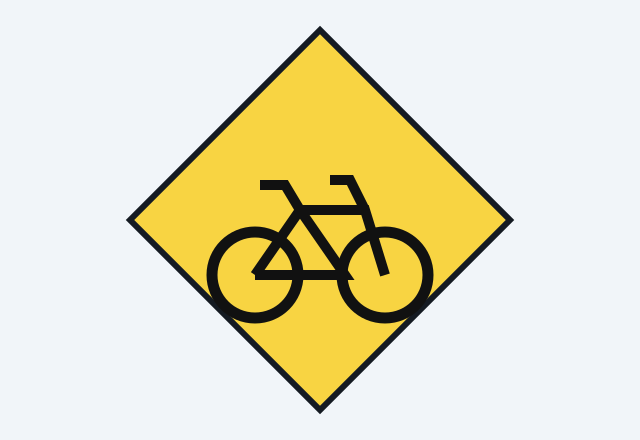
The illustrated BICYCLE CROSSING sign faces your lane. What is the appropriate response?
- A. Pass without checking the adjacent lane.
- B. Expect bicycles only on the sidewalk, not in the travel lanes.
- C. Look for bicyclists and leave safe space.
- D. Use the bike lane as a passing lane.
Show answer
Answer: C. Look for bicyclists and leave safe space.
The warning highlights bicycle activity. Check for riders before turning or changing position.
Question 10 · Signs and Signals
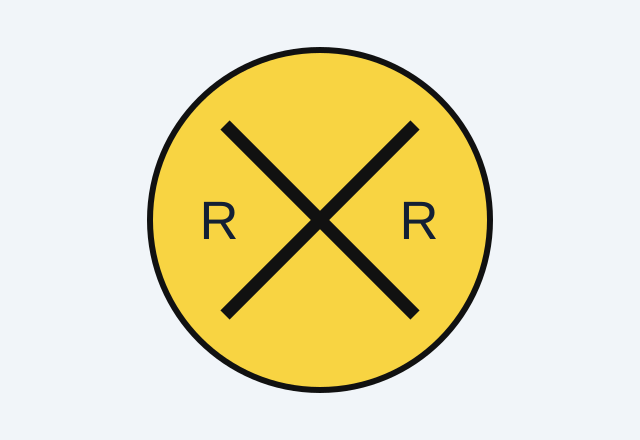
The illustrated RAILROAD CROSSING sign faces your lane. What is the appropriate response?
- A. Reduce speed, check both ways for a train, and be prepared to halt before the tracks.
- B. Slow down only if the crossing has gates.
- C. Race any approaching train.
- D. Stop on the rails to look both ways.
Show answer
Answer: A. Reduce speed, check both ways for a train, and be prepared to halt before the tracks.
This round yellow sign warns of a rail crossing ahead. Approach at a speed that lets you stop short of the tracks if a train is coming.
Question 11 · Signs and Signals
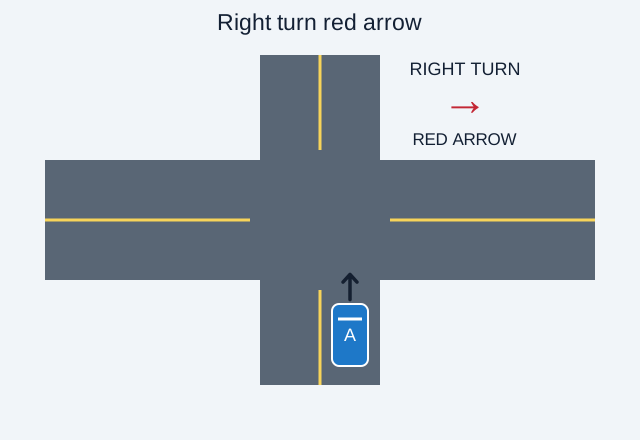
A is in a right-turn lane controlled by a red arrow pointing right. The crosswalk and road appear empty. What should happen next?
- A. A turns once the traffic on the left has cleared.
- B. A keeps waiting at the line until a green arrow or green light allows the turn.
- C. A turns after a full stop.
- D. A treats the arrow as a flashing yellow.
Show answer
Answer: B. A keeps waiting at the line until a green arrow or green light allows the turn.
Unlike a red ball, a red arrow does not allow a turn after stopping. Wait for a green indication even when the road looks empty.
Question 12 · Signs and Signals
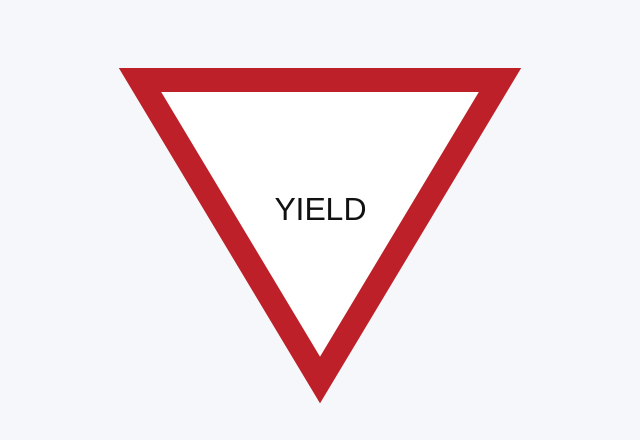
The illustrated YIELD sign faces your lane. What is the appropriate response?
- A. Always enter first.
- B. Treat it as permission to pass.
- C. Keep your speed and continue through.
- D. Give way to conflicting traffic and stop if necessary.
Show answer
Answer: D. Give way to conflicting traffic and stop if necessary.
Yield control requires giving priority to conflicting traffic; stopping is necessary when a safe gap is unavailable.
Question 13 · Signs and Signals
A signal flashes red at a quiet intersection. How should you respond?
- A. Proceed without slowing.
- B. Wait at the line until the signal changes to green, even when no other traffic is around.
- C. Follow the vehicle ahead without stopping.
- D. Come to a full halt, then go once the way is clear and it is your turn.
Show answer
Answer: D. Come to a full halt, then go once the way is clear and it is your turn.
Treat a blinking red the same as a stop sign: a complete stop every time, then normal right-of-way rules decide who goes first.
Question 14 · Signs and Signals
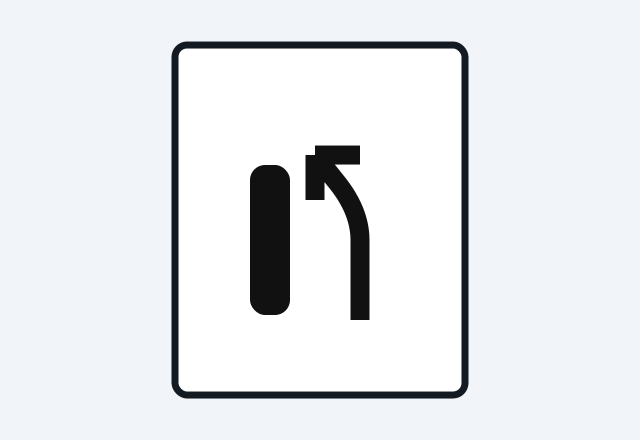
The illustrated KEEP RIGHT sign faces your lane. What is the appropriate response?
- A. Cross into opposing traffic on the left.
- B. Pass on either side of the divider.
- C. Stop beside the divider indefinitely.
- D. Pass to the right of the indicated obstruction or divider.
Show answer
Answer: D. Pass to the right of the indicated obstruction or divider.
Keep-right control directs traffic around the designated obstruction on its right.
Question 15 · Signs and Signals
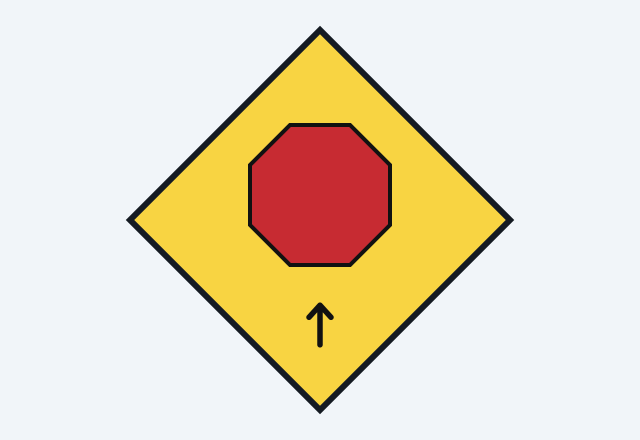
The illustrated STOP AHEAD sign faces your lane. What is the appropriate response?
- A. Prepare to stop at the upcoming stop control.
- B. Ignore the later stop sign.
- C. Stop at this warning sign, then continue through the next intersection.
- D. Accelerate before the junction.
Show answer
Answer: A. Prepare to stop at the upcoming stop control.
The advance warning gives notice of a stop sign farther along the road; the actual control sets the stopping point.
Question 16 · Signs and Signals
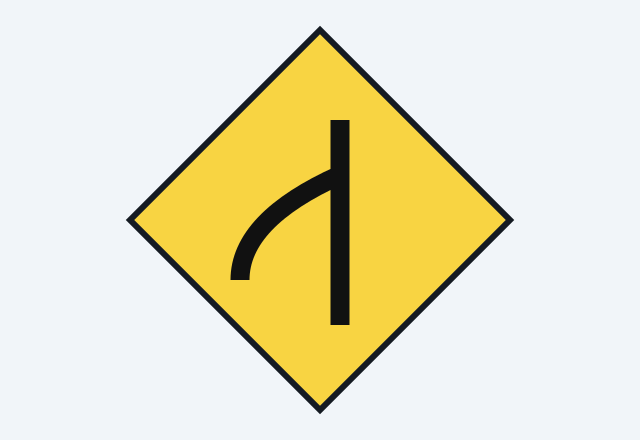
The illustrated MERGE sign faces your lane. What is the appropriate response?
- A. Stop in the through lane so the merging vehicles can enter ahead of you.
- B. Block every merging vehicle.
- C. Assume your lane must end immediately.
- D. Expect joining traffic and adjust spacing safely.
Show answer
Answer: D. Expect joining traffic and adjust spacing safely.
A merge warning means traffic streams will join. Anticipate the conflict and keep a usable gap.
Question 17 · Signs and Signals
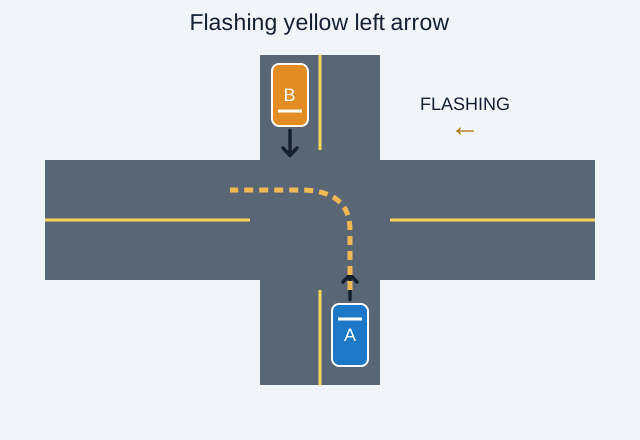
A sees a flashing yellow left arrow. B approaches from the opposite direction on a conflicting through path. What should happen next?
- A. A must wait for B to wave.
- B. A yields to B and turns only when safe.
- C. B must stop for every flashing yellow arrow.
- D. A has a protected turn and proceeds.
Show answer
Answer: B. A yields to B and turns only when safe.
A flashing yellow arrow permits a cautious turn after yielding; it does not provide protection from oncoming traffic.
Question 18 · Signs and Signals
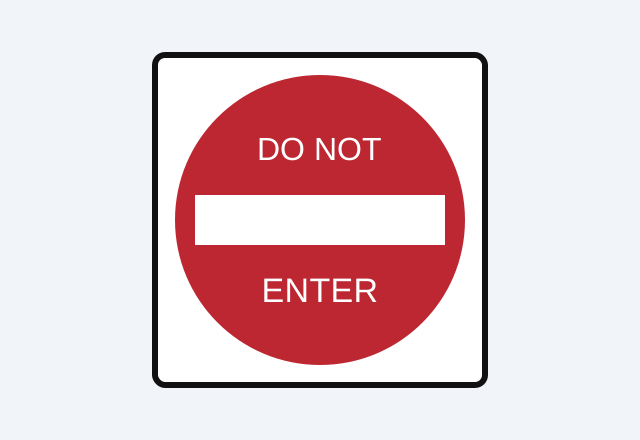
The illustrated DO NOT ENTER sign faces your lane. What is the appropriate response?
- A. Drive through slowly.
- B. Do not enter this roadway from this direction.
- C. Enter only to reach a driveway on this block.
- D. Enter only if the street looks empty and you drive slowly and carefully.
Show answer
Answer: B. Do not enter this roadway from this direction.
This sign prohibits entry from the direction in which it faces approaching traffic.
Question 19 · Signs and Signals
The light turns yellow when you still have room for a smooth safe stop. What should you do?
- A. Accelerate whenever yellow appears.
- B. Halt at the line when a smooth stop is possible; if you are already too close, continue through carefully.
- C. Brake hard and stop at the line every time the light turns yellow, however close you are and whoever is behind you.
- D. Treat yellow as a fresh green.
Show answer
Answer: B. Halt at the line when a smooth stop is possible; if you are already too close, continue through carefully.
A steady yellow tells you the red is coming. Judge whether you can come to a controlled stop before the line. If braking hard would be dangerous, carry on through with care instead of speeding up.
Question 20 · Signs and Signals
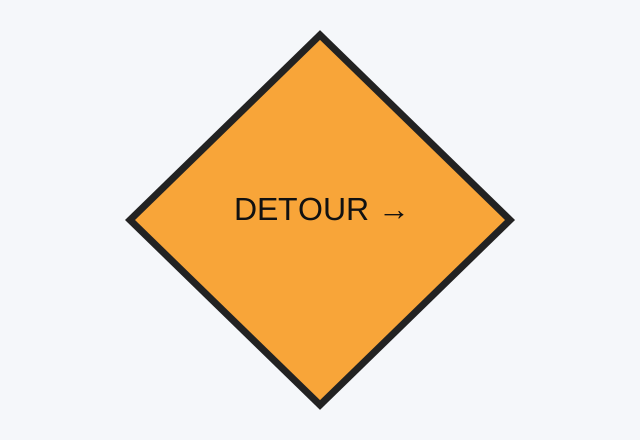
The illustrated DETOUR → sign faces your lane. What is the appropriate response?
- A. Travel against traffic to bypass the closure.
- B. Ignore the temporary signs and use your GPS to find the fastest route.
- C. Drive around the closure barriers.
- D. Follow the signed alternate route in the indicated direction.
Show answer
Answer: D. Follow the signed alternate route in the indicated direction.
A detour routes traffic around a disruption. Follow the temporary signs and other controls.
Ready to test yourself?
Take a 20-question practice exam with the answers hidden. You get a score (aim for 16 of 20 or better) and an explanation for every answer. For the DMV’s own test format, see about the permit test.
More free practice and lessons
- Free California DMV practice test
- Rules of the road practice test
- California DMV Practice Mock Exam 1 with answers
- California DMV Practice Mock Exam 2 with answers
- California DMV Practice Mock Exam 3 with answers
- California DMV Practice Mock Exam 4 with answers
- California DMV Practice Mock Exam 5 with answers
- California DMV Practice Mock Exam 6 with answers
- California DMV Practice Mock Exam 7 with answers
- Signs and Signals
- Right of Way and Crossings
- Lanes and Turns
- Parking and Backing
- Sharing the Road
- Safe Driving and Hazards
- Alcohol, Drugs and Distraction
- Permits and Test Preparation
- About the California permit test
- 7-day study plan
- Permit test tips