California DMV Practice Mock Exam 7
All 20 questions from Mock Exam 7, with answers and explanations.
A mixed exam: 5 sign questions, 5 road diagrams and 10 questions on the rules of the road, including safe driving and hazards, lanes and turns and parking and backing.
These are the 20 questions from Mock Exam 7, original practice questions on signs and the rules of the road, checked against the California Driver Handbook. Read through them with Show answer, or take the exam online first with the answers hidden and see your score. No sign-in needed.
These are original practice questions, not actual DMV test questions. Each links to the California Driver Handbook so you can check the rule. Questions were last reviewed in November 2026; read how we write and check them.
Question 1 · Safe Driving and Hazards
About how far ahead should you look while driving in town?
- A. About 10 to 15 seconds ahead.
- B. About 1 to 2 seconds ahead.
- C. Only as far as the next bumper.
- D. About a full minute ahead.
Show answer
Answer: A. About 10 to 15 seconds ahead.
Looking 10 to 15 seconds ahead, about a block in town, gives you time to spot problems early.
Question 2 · Sharing the Road
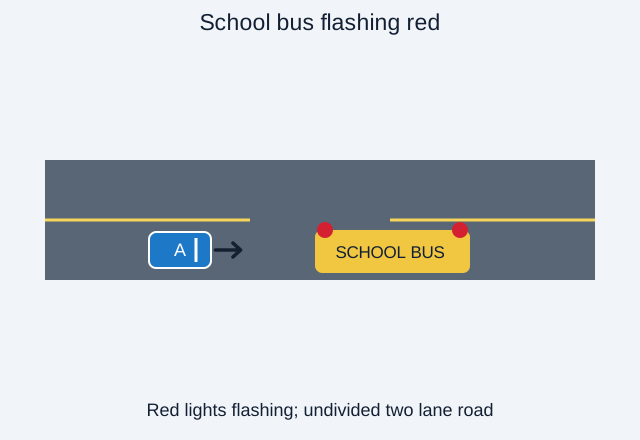
On this undivided two-lane road, who must stop for the bus's flashing red lights?
- A. Only vehicles behind the bus.
- B. Only vehicles coming toward the bus.
- C. Traffic in both directions.
- D. Nobody, if no child is visible.
Show answer
Answer: C. Traffic in both directions.
Children may cross in front of the bus, so drivers coming from either direction must stop.
Question 3 · Sharing the Road
Which of these does California's move-over law cover?
- A. A parked car with no lights on.
- B. A city bus stopped at a station with its flashers on to let riders off.
- C. A bicyclist riding in a bike lane.
- D. A tow truck with flashing amber lights on the shoulder.
Show answer
Answer: D. A tow truck with flashing amber lights on the shoulder.
The rule protects ambulances, tow trucks, highway maintenance trucks and similar vehicles stopped with lights flashing. Change lanes away from them, or slow down if you can't.
Question 4 · Signs and Signals
A flashing red signal should be treated the same as which of these?
- A. A STOP sign.
- B. A YIELD sign.
- C. A green light.
- D. A flashing yellow light.
Show answer
Answer: A. A STOP sign.
At a flashing red, stop completely, then go when it is your turn and safe, just as at a STOP sign.
Question 5 · Signs and Signals
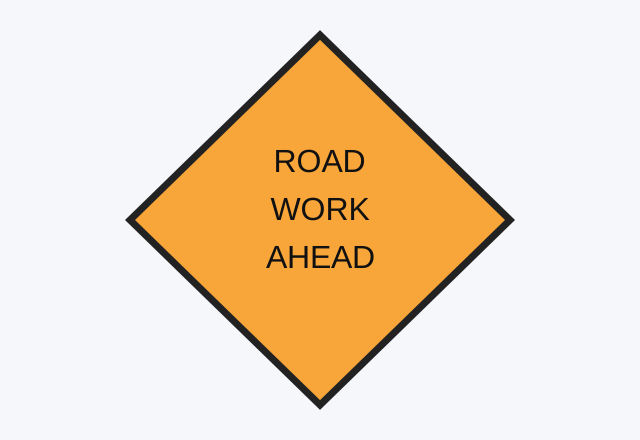
A flagger in the work zone after the pictured sign holds up a SLOW paddle. What should you do?
- A. Stop completely and wait for the temporary traffic light to turn green.
- B. Speed up to clear the area quickly.
- C. Change lanes to pass the workers.
- D. Proceed slowly and follow the flagger's directions.
Show answer
Answer: D. Proceed slowly and follow the flagger's directions.
Flaggers control traffic in work zones. Their signals must be obeyed.
Question 6 · Signs and Signals
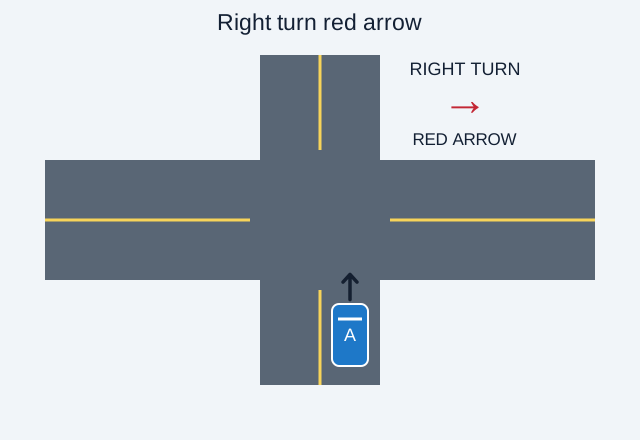
How is this red right arrow different from a solid red light for a right turn?
- A. There is no difference.
- B. A red arrow allows a right turn after a full stop, just like a solid red light does, unless a sign says otherwise.
- C. On the red arrow A may not turn; on a solid red, A may turn after stopping unless a sign forbids it.
- D. A solid red never allows a right turn.
Show answer
Answer: C. On the red arrow A may not turn; on a solid red, A may turn after stopping unless a sign forbids it.
A solid red allows a right turn after a full stop when it is safe. A red arrow does not.
Question 7 · Safe Driving and Hazards
Using a roadside marker, how much time should you normally keep between you and the car ahead in good conditions?
- A. About one second.
- B. Exactly one car length.
- C. Half a second per 10 mph.
- D. At least three seconds.
Show answer
Answer: D. At least three seconds.
Start counting when the car ahead passes a fixed marker; you should not reach it in under three seconds.
Question 8 · Parking and Backing
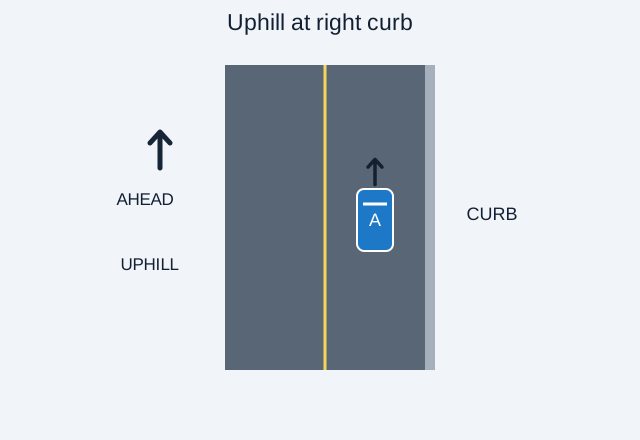
Why should A turn the front tires away from the curb when parked facing uphill?
- A. If the car rolls back, the back of the front tire rests against the curb.
- B. So A can pull out faster.
- C. Turning away keeps the tires out of the gutter, where water could make the car slide back.
- D. So the parking brake isn't needed.
Show answer
Answer: A. If the car rolls back, the back of the front tire rests against the curb.
Uphill, the danger is rolling backward. Tires turned toward the street let the curb catch the wheel.
Question 9 · Right of Way and Crossings
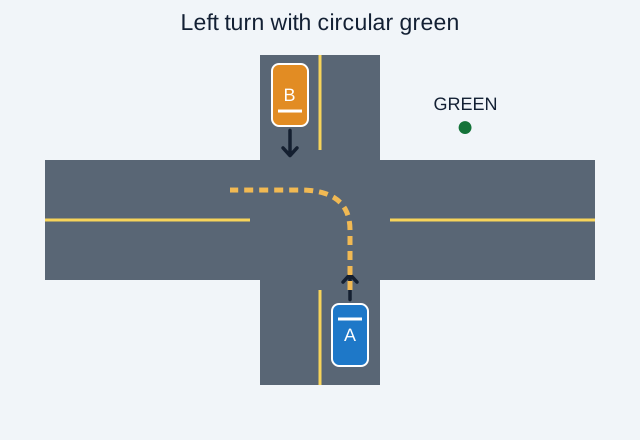
A is facing north on a circular green and wants to turn left while B comes straight through from the other side. Why can't A treat the green light as protection?
- A. A circular green allows the turn but does not stop oncoming traffic, so A must yield.
- B. Green means A has priority over all other traffic.
- C. Left turns are controlled only by arrows, so the green does not apply.
- D. B's light must be red whenever A's is green.
Show answer
Answer: A. A circular green allows the turn but does not stop oncoming traffic, so A must yield.
Only a green arrow holds back the oncoming lanes. With a plain green, oncoming drivers going straight keep the right of way.
Question 10 · Lanes and Turns
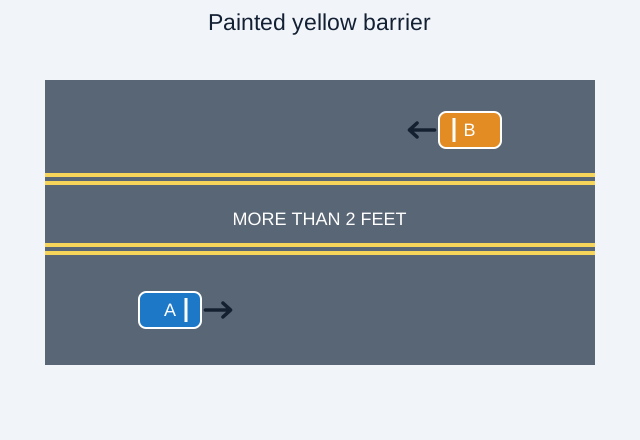
The wide painted area next to A is outlined by double yellow lines on both edges. What does that marking mean?
- A. A shared center lane that drivers from both directions may use to begin left turns.
- B. A space for passing.
- C. A barrier that works like a solid median.
- D. A parking area.
Show answer
Answer: C. A barrier that works like a solid median.
Paint can act as a divider. When both edges are double yellow and the space between is wide, treat it like a raised median.
Question 11 · Signs and Signals
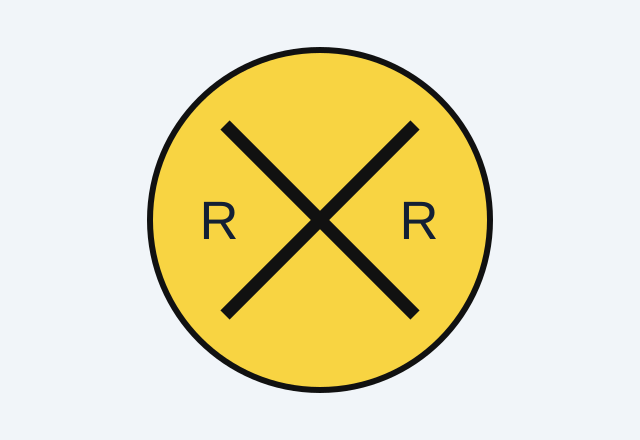
You pass the pictured RAILROAD CROSSING sign. How far before the tracks should you stop if a train is coming?
- A. Right on the edge of the first rail.
- B. Between the rails.
- C. Within 5 feet of the crossing, close enough to see down the tracks.
- D. At least 15 feet from the nearest rail.
Show answer
Answer: D. At least 15 feet from the nearest rail.
California law requires stopping between 15 and 50 feet from the nearest rail when a train is approaching or signals are active.
Question 12 · Signs and Signals
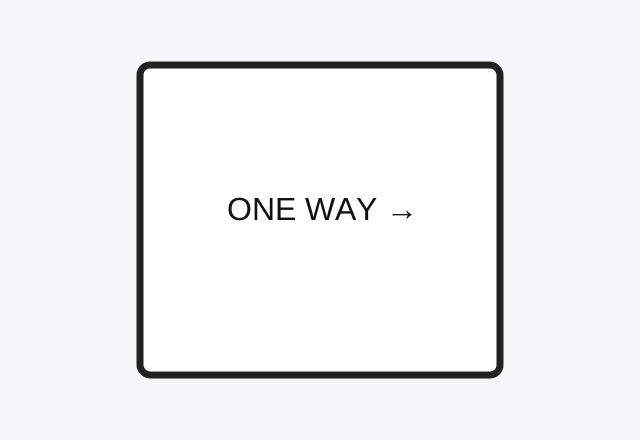
You're on the street marked by the pictured ONE WAY sign and want to turn left onto another street. Which lane should you turn from?
- A. The rightmost lane.
- B. The leftmost lane.
- C. Any lane, if you signal.
- D. The middle lane.
Show answer
Answer: B. The leftmost lane.
On a one-way street, make a left turn from the lane nearest the left side of the road.
Question 13 · Signs and Signals
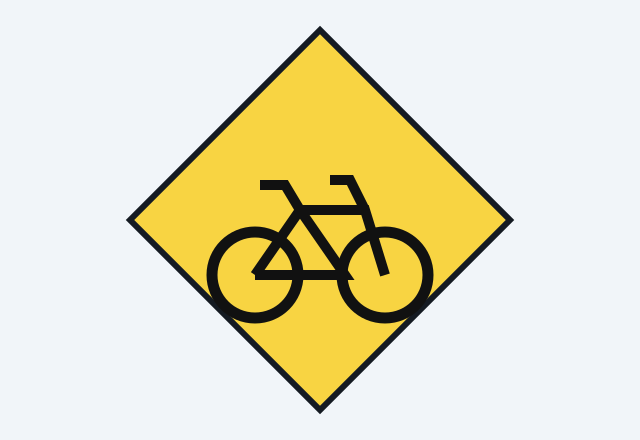
You want to pass a bicyclist near the pictured sign. How much space must you leave?
- A. At least 3 feet, and more when you can.
- B. At least 1 foot.
- C. Any space, if you honk first.
- D. None, if the bicyclist is in a bike lane.
Show answer
Answer: A. At least 3 feet, and more when you can.
California law requires at least 3 feet when passing a bicyclist. If you can't, slow down and wait.
Question 14 · Right of Way and Crossings
A ball bounces into the street near a school. What should you expect?
- A. The ball will stop on its own.
- B. A child may run out after it.
- C. Someone will throw it back.
- D. Nothing, if no one is in sight.
Show answer
Answer: B. A child may run out after it.
Where there's a ball, a child often follows. Ease off and get ready to brake.
Question 15 · Permits and Test Preparation
How many hours of supervised practice must a minor complete for a provisional license?
- A. 30 hours, including 5 at night.
- B. 100 hours, all of them in daylight.
- C. 20 hours, including 2 at night.
- D. 50 hours, including 10 at night.
Show answer
Answer: D. 50 hours, including 10 at night.
Minors need 50 hours of adult-supervised practice, and 10 of those hours must be at night.
Question 16 · Parking and Backing
How long may you leave your car door open on the traffic side?
- A. As long as your hazard lights are on and flashing.
- B. Up to five minutes.
- C. Only as long as it takes to load or unload.
- D. As long as you stay beside it.
Show answer
Answer: C. Only as long as it takes to load or unload.
An open door sticks into the lane, so close it as soon as you've loaded or unloaded.
Question 17 · Safe Driving and Hazards
Until what age must a child ride in a rear-facing car seat in California?
- A. Under 2, unless they're at least 40 pounds or 40 inches tall.
- B. Under 1, regardless of the child's height or weight.
- C. Under 4, regardless of their size.
- D. Under 6, unless they can sit up alone.
Show answer
Answer: A. Under 2, unless they're at least 40 pounds or 40 inches tall.
Children under 2 ride rear-facing unless they weigh 40 pounds or more or are 40 inches or taller.
Question 18 · Lanes and Turns
When should you start moving toward your freeway exit?
- A. Well ahead, so you're in the exit lane before the exit.
- B. At the very last moment.
- C. Only after you've reached the start of the exit ramp.
- D. Once you've passed the exit sign.
Show answer
Answer: A. Well ahead, so you're in the exit lane before the exit.
Plan early. Late lane changes across traffic are a common cause of crashes.
Question 19 · Signs and Signals
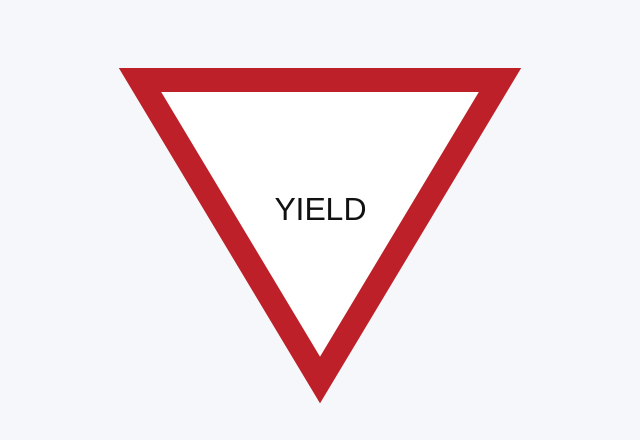
You reach the pictured YIELD sign and cross traffic is approaching close by. What should you do?
- A. Speed up to merge in ahead of it.
- B. Stop only if the other driver sounds the horn or flashes headlights at you.
- C. Keep going, because yield signs never require a stop.
- D. Slow down or stop and let that traffic pass before going.
Show answer
Answer: D. Slow down or stop and let that traffic pass before going.
A yield sign means others go first. If they are close, you may have to stop completely.
Question 20 · Alcohol, Drugs and Distraction
Which of these is an early sign that you're too tired to drive?
- A. Feeling a little hungry.
- B. Wanting to change the radio station.
- C. Drifting out of your lane or missing your exit.
- D. Noticing more road signs and details than you usually would.
Show answer
Answer: C. Drifting out of your lane or missing your exit.
Lane drifting, heavy eyelids and missed turns mean it's time to stop and rest.
Ready to test yourself?
Take a 20-question practice exam with the answers hidden. You get a score (aim for 16 of 20 or better) and an explanation for every answer. For the DMV’s own test format, see about the permit test.
More free practice and lessons
- Free California DMV practice test
- Road signs practice test
- Rules of the road practice test
- California DMV Practice Mock Exam 1 with answers
- California DMV Practice Mock Exam 2 with answers
- California DMV Practice Mock Exam 3 with answers
- California DMV Practice Mock Exam 4 with answers
- California DMV Practice Mock Exam 5 with answers
- California DMV Practice Mock Exam 6 with answers
- Signs and Signals
- Right of Way and Crossings
- Lanes and Turns
- Parking and Backing
- Sharing the Road
- Safe Driving and Hazards
- Alcohol, Drugs and Distraction
- Permits and Test Preparation
- About the California permit test
- 7-day study plan
- Permit test tips