California DMV Practice Mock Exam 4
All 20 questions from Mock Exam 4, with answers and explanations.
A mixed exam: 5 sign questions, 5 road diagrams and 10 questions on the rules of the road, including lanes and turns, sharing the road and right of way and crossings.
These are the 20 questions from Mock Exam 4, original practice questions on signs and the rules of the road, checked against the California Driver Handbook. Read through them with Show answer, or take the exam online first with the answers hidden and see your score. No sign-in needed.
These are original practice questions, not actual DMV test questions. Each links to the California Driver Handbook so you can check the rule. Questions were last reviewed in November 2026; read how we write and check them.
Question 1 · Alcohol, Drugs and Distraction
After drinking, you feel confident but notice slower reactions. What should you do?
- A. Drink a strong coffee and wait twenty minutes, then drive home carefully and slowly.
- B. Drive slowly as a substitute for sobriety.
- C. Assume feeling confident proves fitness.
- D. Arrange a sober ride and do not drive if affected by alcohol.
Show answer
Answer: D. Arrange a sober ride and do not drive if affected by alcohol.
Alcohol can affect judgment before a person recognizes the impairment; a low reading does not establish safe driving.
Question 2 · Signs and Signals
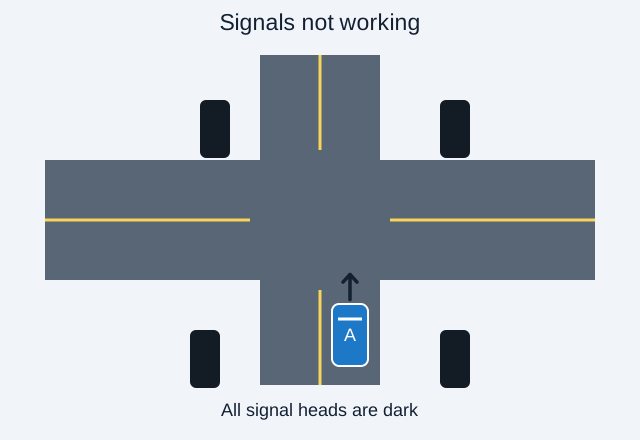
All signal heads at the pictured intersection are dark because of a power outage. A is approaching the stop line. What should happen next?
- A. The wider road automatically has priority without stopping.
- B. A stops and treats the intersection as an all-way stop.
- C. Only turning cars stop.
- D. A keeps normal speed.
Show answer
Answer: B. A stops and treats the intersection as an all-way stop.
An inoperative signal is handled as stop control in all directions.
Question 3 · Permits and Test Preparation
A 24-year-old new driver has an instruction permit. What supervision is needed for practice?
- A. Practice alone on quiet streets, since adults don't need a supervisor with a permit.
- B. Practice with a California-licensed driver at least 18 who can take control if necessary.
- C. Use a remote video call as supervision.
- D. Use an unlicensed adult passenger.
Show answer
Answer: B. Practice with a California-licensed driver at least 18 who can take control if necessary.
An adult instruction permit still requires qualifying in-person supervision during practice.
Question 4 · Lanes and Turns
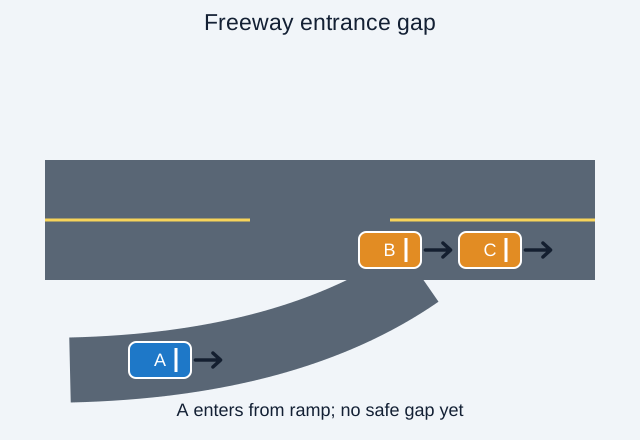
A is on an entrance ramp. B and C are in the freeway lane, with no safe gap currently available. What should happen next?
- A. A signals and merges at the end of the ramp.
- B. A forces B and C to brake sharply.
- C. A enters regardless of the gap.
- D. A adjusts speed on the ramp and merges only into a safe gap.
Show answer
Answer: D. A adjusts speed on the ramp and merges only into a safe gap.
Entering traffic must yield; a signal communicates intent but does not create a right to merge.
Question 5 · Right of Way and Crossings
You approach an ordinary California roundabout for the first time. Which direction should you follow?
- A. Bear right on entry and circle counterclockwise around the center island.
- B. Stop inside the roundabout to choose an exit.
- C. Drive over the central island.
- D. Turn left as you enter and go clockwise, so you reach left-side exits sooner.
Show answer
Answer: A. Bear right on entry and circle counterclockwise around the center island.
All traffic in a California roundabout circles counterclockwise. Yield to cars already circulating, enter to the right and stay in your lane until your exit.
Question 6 · Signs and Signals
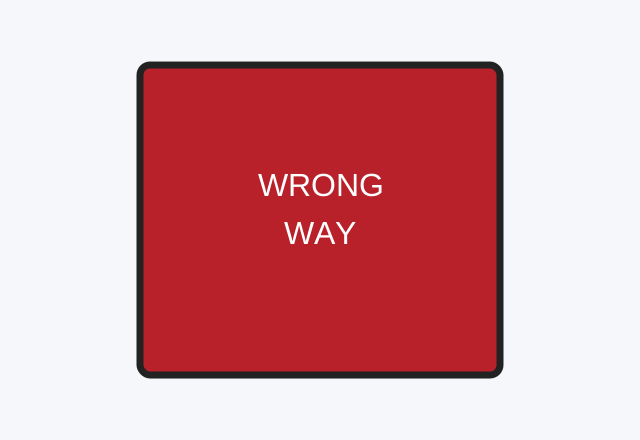
The illustrated WRONG WAY sign faces your lane. What is the appropriate response?
- A. Drive faster to leave quickly.
- B. Use the shoulder to continue against traffic.
- C. Continue carefully to the next exit with your hazard lights flashing.
- D. Stop safely and correct your direction without endangering traffic.
Show answer
Answer: D. Stop safely and correct your direction without endangering traffic.
The warning indicates travel against the permitted flow. Avoid continuing into opposing traffic.
Question 7 · Signs and Signals
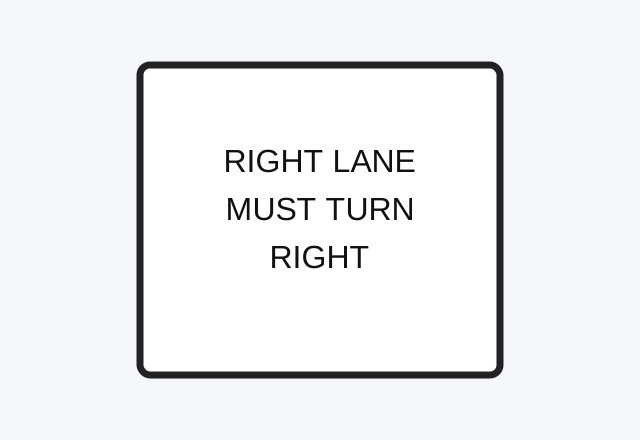
The illustrated RIGHT LANE MUST TURN RIGHT sign faces your lane. What is the appropriate response?
- A. Use this lane for the required right turn.
- B. Turn left from the lane.
- C. Drive straight from the lane.
- D. Use the lane to pass then cut across the intersection.
Show answer
Answer: A. Use this lane for the required right turn.
The lane-use sign requires a right turn from the designated lane.
Question 8 · Parking and Backing
An empty blue-curb space is closest to a store. You have no disabled parking authorization. What applies?
- A. Use it for a quick errand of a few minutes.
- B. Use the space only with the required valid disabled parking authorization.
- C. Borrow someone’s placard for personal convenience.
- D. Use it for deliveries without authorization.
Show answer
Answer: B. Use the space only with the required valid disabled parking authorization.
Blue curb parking is reserved for people displaying the required valid disabled parking authorization.
Question 9 · Lanes and Turns
Before you leave your lane to pass, you notice an oncoming vehicle closing quickly. What should you do?
- A. Compete with an oncoming driver for space.
- B. Avoid forcing the pass and return to a safe position when possible.
- C. Expect the oncoming car to leave the road.
- D. Continue the pass and speed up, since the oncoming driver will slow down for you.
Show answer
Answer: B. Avoid forcing the pass and return to a safe position when possible.
Do not commit other road users to an emergency maneuver. Preserve a safe escape route and abandon an unsafe pass.
Question 10 · Signs and Signals
A signal is flashing yellow over your lane. How should you approach?
- A. Accelerate through without scanning.
- B. Ease your speed, watch for cross traffic and people, and continue without a required stop.
- C. Treat it like a protected green arrow and continue, since cross traffic must stop for you.
- D. Ignore the intersection completely.
Show answer
Answer: B. Ease your speed, watch for cross traffic and people, and continue without a required stop.
A blinking yellow is a warning, not a stop order. You may keep moving, but approach ready to react because other road users may not yield to you.
Question 11 · Signs and Signals
A stop sign has a clearly marked limit line. Where should you make the required stop?
- A. Roll through unless traffic is present.
- B. Stop with your front bumper just past the line so you can see cross traffic, then go when clear.
- C. Stop where your hood reaches the center of the junction.
- D. Halt behind the painted limit line; with no line, halt before the crosswalk; with neither, halt before the cross street.
Show answer
Answer: D. Halt behind the painted limit line; with no line, halt before the crosswalk; with neither, halt before the cross street.
Where you stop keeps the crossing area clear for pedestrians and gives you a view of cross traffic. Use whichever marking is closest to you.
Question 12 · Signs and Signals
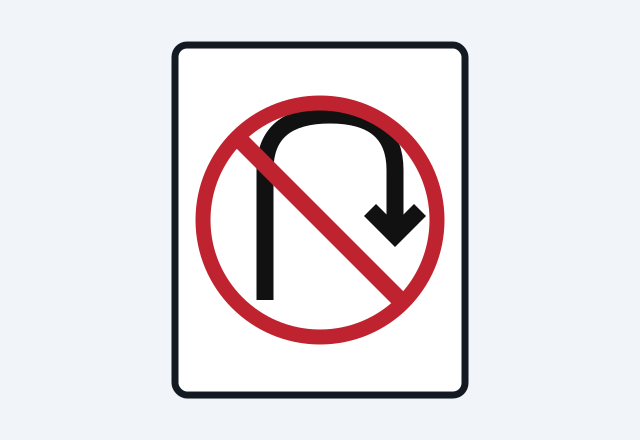
The illustrated NO U TURN sign faces your lane. What is the appropriate response?
- A. Choose a different legal place to reverse direction.
- B. Make a U-turn if no cars are coming from either direction for a long distance.
- C. Ignore the sign after sunset.
- D. Make a U-turn only from the shoulder.
Show answer
Answer: A. Choose a different legal place to reverse direction.
A no-U-turn sign prohibits that maneuver at the controlled location.
Question 13 · Lanes and Turns
You plan a turn on a quiet residential street. What should you do before beginning it?
- A. Use a signal to demand priority.
- B. Signal once you have started turning, so others see exactly where you are going.
- C. Signal your intention early enough for others to respond.
- D. Skip signaling whenever the road looks empty.
Show answer
Answer: C. Signal your intention early enough for others to respond.
Signaling communicates intent; it does not create right-of-way or replace a traffic check.
Question 14 · Right of Way and Crossings
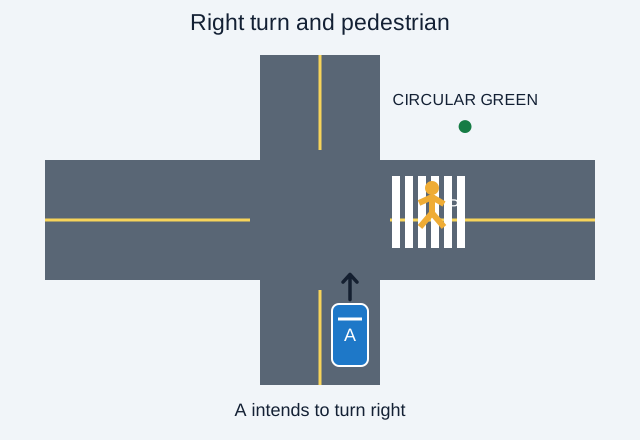
A intends to turn right. P is walking across A’s intended path in the crosswalk. What should happen next?
- A. A turns in front of P.
- B. A waits until the pedestrian conflict has cleared safely.
- C. A honks and keeps turning.
- D. A turns behind P while P is still in the crosswalk.
Show answer
Answer: B. A waits until the pedestrian conflict has cleared safely.
A turning driver must yield to a pedestrian in the conflicting crosswalk.
Question 15 · Sharing the Road
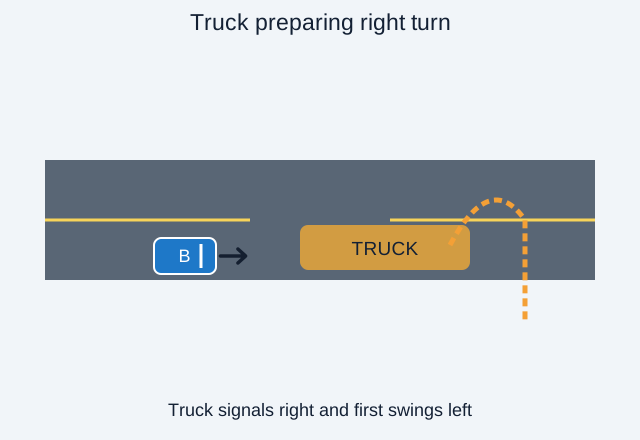
A truck indicates a right turn and swings left to make room. Car B is behind it near the right curb. What should happen next?
- A. B stays back rather than entering the space beside the turning truck.
- B. B squeezes between the truck and curb.
- C. B passes on the sidewalk.
- D. B moves up on the truck's right side.
Show answer
Answer: A. B stays back rather than entering the space beside the turning truck.
A large vehicle may need a wide approach. The inside space can close as its rear wheels follow a tighter path.
Question 16 · Sharing the Road
You have been traveling beside a truck’s trailer for several seconds. What should you aim to do safely?
- A. Follow so closely that the truck mirrors disappear.
- B. Stay close beside the trailer wheels.
- C. Stay right beside the trailer wheels so the truck driver can see you clearly out the side window.
- D. Avoid lingering beside the truck and maintain a visible safe position.
Show answer
Answer: D. Avoid lingering beside the truck and maintain a visible safe position.
Large trucks have extensive blind spots; a safe position and space reduce the risk of being unseen.
Question 17 · Signs and Signals
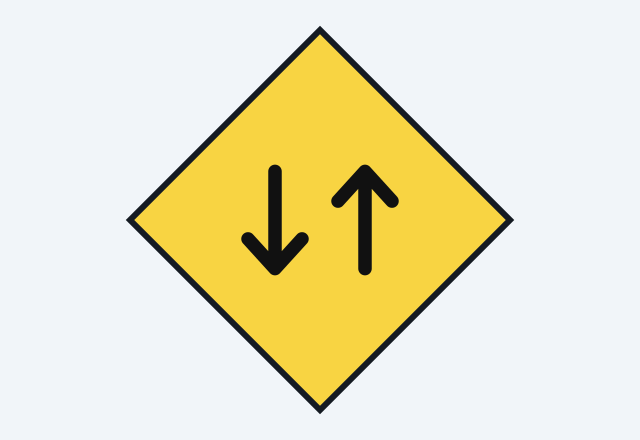
The illustrated TWO WAY TRAFFIC sign faces your lane. What is the appropriate response?
- A. Overtake without checking opposing traffic.
- B. Use both lanes in one direction.
- C. Expect vehicles traveling toward you as well as with you.
- D. Assume all the lanes still carry traffic in your direction only.
Show answer
Answer: C. Expect vehicles traveling toward you as well as with you.
This warning alerts drivers to opposing traffic flow.
Question 18 · Signs and Signals
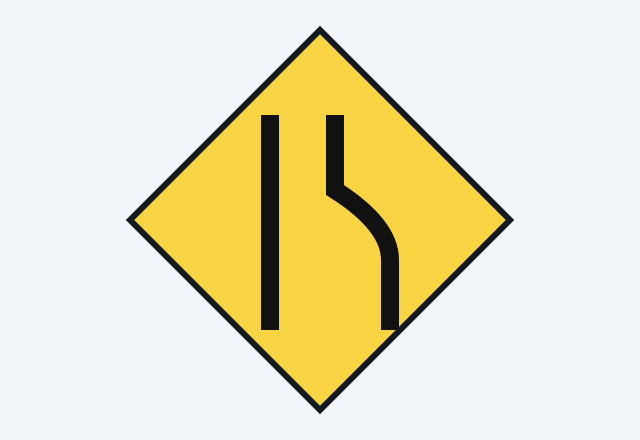
The illustrated LANE ENDS sign faces your lane. What is the appropriate response?
- A. Continue onto the shoulder.
- B. Stay in your lane until you reach the barrier, then signal and move over.
- C. Plan a safe lane change before your lane disappears.
- D. Force adjacent traffic to brake.
Show answer
Answer: C. Plan a safe lane change before your lane disappears.
A lane-end warning gives time to signal, check gaps, and merge safely.
Question 19 · Sharing the Road
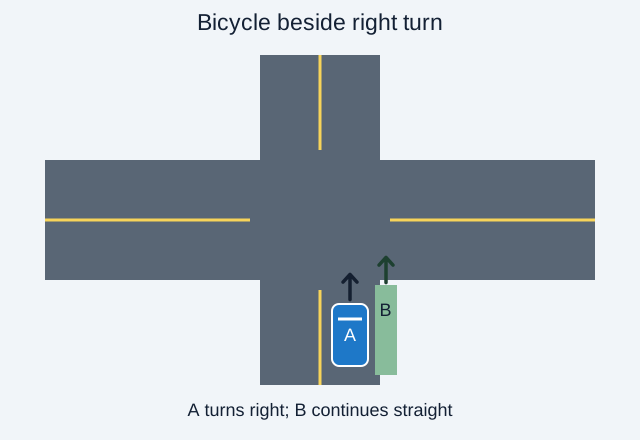
A is preparing to turn right. B is riding forward in the adjacent bike lane, within the turning conflict area. What should happen next?
- A. Force B onto the sidewalk.
- B. Turn across B without looking.
- C. Check the right blind spot and yield rather than cut across B.
- D. Turn right in front of B once the turn signal is on.
Show answer
Answer: C. Check the right blind spot and yield rather than cut across B.
A right-turning driver must look for and yield to a bicyclist in the turn path.
Question 20 · Safe Driving and Hazards
Your car reaches a rain-soaked section after a dry stretch. What driving adjustment is appropriate?
- A. Turn on cruise control to keep your speed steady across the wet section.
- B. Accelerate across standing water.
- C. Make sharp steering inputs to test grip.
- D. Reduce speed smoothly and avoid abrupt steering or braking.
Show answer
Answer: D. Reduce speed smoothly and avoid abrupt steering or braking.
Water reduces tire grip and can cause loss of contact with the road; smooth control reduces demands on traction.
Ready to test yourself?
Take a 20-question practice exam with the answers hidden. You get a score (aim for 16 of 20 or better) and an explanation for every answer. For the DMV’s own test format, see about the permit test.
More free practice and lessons
- Free California DMV practice test
- Road signs practice test
- Rules of the road practice test
- California DMV Practice Mock Exam 1 with answers
- California DMV Practice Mock Exam 2 with answers
- California DMV Practice Mock Exam 3 with answers
- California DMV Practice Mock Exam 5 with answers
- California DMV Practice Mock Exam 6 with answers
- California DMV Practice Mock Exam 7 with answers
- Signs and Signals
- Right of Way and Crossings
- Lanes and Turns
- Parking and Backing
- Sharing the Road
- Safe Driving and Hazards
- Alcohol, Drugs and Distraction
- Permits and Test Preparation
- About the California permit test
- 7-day study plan
- Permit test tips