By the ChowChow Labs editorial team · Updated November 6, 2026 · How we check our content
Parking on a hill
Legal rule
Set the parking brake and use the curb as a backstop. Facing downhill, angle the tires in toward the curb. Facing uphill, angle them out toward the street. With no curb, aim them toward the shoulder so a rolling car leaves the roadway.
Example: You park uphill on a San Francisco street with a curb. You turn the wheel left, let the car settle back against the curb, and set the brake.
Check the official wording in the California Driver Handbook.
Curb colors
Legal rule
Red: no stopping or parking. Yellow: loading only, for the time posted. White: brief passenger or mail stops. Green: limited-time parking. Blue: only for vehicles displaying a valid disabled placard or plate.
Example: You need to drop off a friend. A white curb is fine for a quick stop; a red curb is not.
Check the official wording in the California Driver Handbook.
Backing up and opening doors
Safety recommendation
Before reversing, look around the car and turn to look through the rear window; cameras help but miss things. Before opening a door on the traffic side, check for bikes and cars approaching from behind.
Example: Your backup camera is clear, but children were playing nearby, so you walk around the car before you reverse.
Check the official wording in the California Driver Handbook.
Check yourself
Try these 6 questions from our free mock exams, then tap Show answer. For more, take the rules of the road practice test.
Question 1 · Parking and Backing
You are about to reverse out of a parking place. What should happen first?
- A. Use the camera as the only check.
- B. Check around the vehicle and blind spots, then back slowly while continuing to observe.
- C. Back quickly before anyone arrives.
- D. Rely on the backup camera alone.
Show answer
Answer: B. Check around the vehicle and blind spots, then back slowly while continuing to observe.
Backing requires direct awareness of people and obstacles; a camera supplements observation.
Question 2 · Parking and Backing
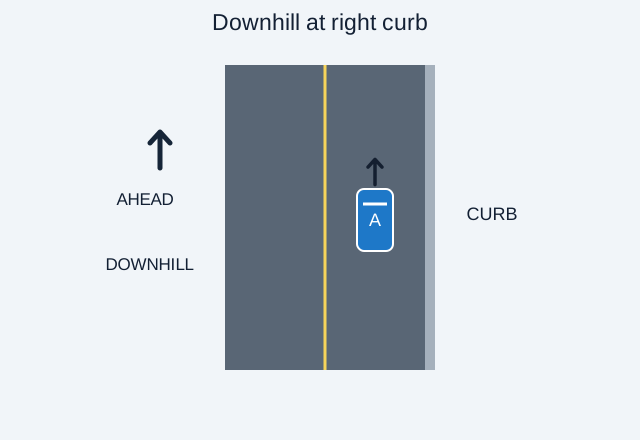
A is parked facing downhill beside a curb on its right. What should happen next?
- A. Turn the front wheels away from the curb so they would roll toward the street, then set the brake.
- B. Rely only on steering lock.
- C. Leave the wheels straight and release the brake.
- D. Steer the front tires in against the curb, then apply the parking brake.
Show answer
Answer: D. Steer the front tires in against the curb, then apply the parking brake.
Facing downhill with a curb on the right, angle the tires into the curb. If the car creeps forward, the curb catches the front wheel instead of letting it roll into the street.
Question 3 · Parking and Backing
You park beside a bicycle route and want to get out. What should you do before opening the door?
- A. Open immediately to claim space.
- B. Ask a passenger to watch for traffic and open the door when they tell you it looks clear.
- C. Look in the mirror and turn to look behind for cyclists and cars, then open the door slowly.
- D. Assume parked cars cannot create a hazard.
Show answer
Answer: C. Look in the mirror and turn to look behind for cyclists and cars, then open the door slowly.
A door swung open into a bike lane is a common cause of serious cyclist injuries. A quick look back first prevents it.
Question 4 · Parking and Backing
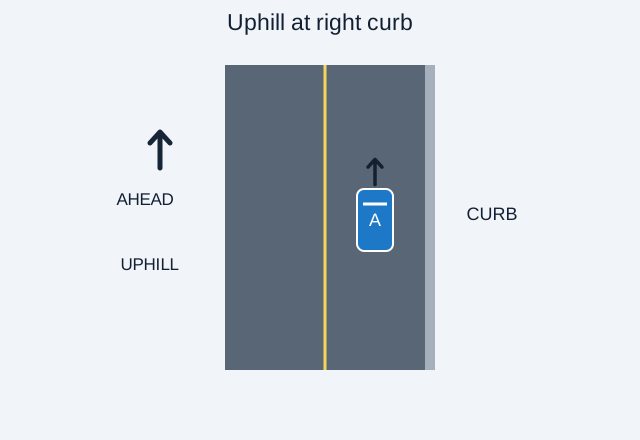
A is parked facing uphill beside a curb on its right. What should happen next?
- A. Turn the front wheels in toward the curb, the same as parking downhill, then set the parking brake.
- B. Release the parking brake.
- C. Angle the front tires out toward the street so they would roll back into the curb, then apply the parking brake.
- D. Leave the vehicle in neutral without a brake.
Show answer
Answer: C. Angle the front tires out toward the street so they would roll back into the curb, then apply the parking brake.
Facing uphill with a curb, point the tires toward the street. A small rollback then rests the rear of the front tire against the curb, which holds the car.
Question 5 · Parking and Backing
You see an ordinary red curb and want to wait for a friend. What rule applies?
- A. Keep moving: a red curb is off-limits even for a brief wait, unless a posted exception covers you.
- B. Wait there whenever the engine remains running.
- C. Wait there briefly with your hazard lights on.
- D. Park for a few minutes with hazards on.
Show answer
Answer: A. Keep moving: a red curb is off-limits even for a brief wait, unless a posted exception covers you.
Red paint marks space that must stay open, such as near hydrants or fire lanes. Running the engine or turning on hazard lights does not make a stop there legal.
Question 6 · Parking and Backing
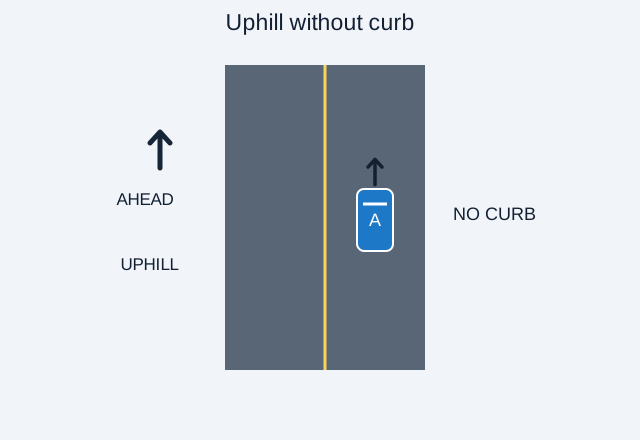
A is parked facing uphill on the right side of a road without a curb. What should happen next?
- A. Keep the wheels straight and omit the brake.
- B. Steer the tires toward the road's edge (to the right) so any roll carries the car off the roadway.
- C. Park facing opposing traffic.
- D. Steer the tires toward the center of the road, the same way you would with a curb uphill.
Show answer
Answer: B. Steer the tires toward the road's edge (to the right) so any roll carries the car off the roadway.
With no curb to catch a wheel, aim the tires toward the shoulder. If the brake slips, the car drifts off the edge rather than into passing traffic.
Next: Sharing the Road. Bicyclists, large trucks, school buses and emergency vehicles.