Free California DMV Practice Test
20 questions with answers and explanations. No sign-up needed.
California DMV Prep 2026 is an independent study aid by ChowChow Labs. It is not affiliated with or endorsed by the California DMV or the State of California. The questions are original practice questions, not actual DMV test questions, and practice scores don't guarantee you'll pass. Always study the current official California Driver Handbook.
The California DMV knowledge test checks what you know about traffic signs, the rules of the road and safe driving. Try these 20 sample questions, then tap Show answer to check yourself and read why.
Every question is written by ChowChow Labs and checked against the California Driver Handbook. They cover the same topics as the handbook: signs and signals, right of way, lanes and turns, parking, sharing the road, safe driving, alcohol and distraction, and permit rules. They aren’t actual DMV test questions.
Want to focus? Try the road signs test or the rules of the road test, or follow the 7-day study plan.
These are original practice questions, not actual DMV test questions. Each links to the California Driver Handbook so you can check the rule. Questions were last reviewed in November 2026; read how we write and check them.
Question 1 · Lanes and Turns
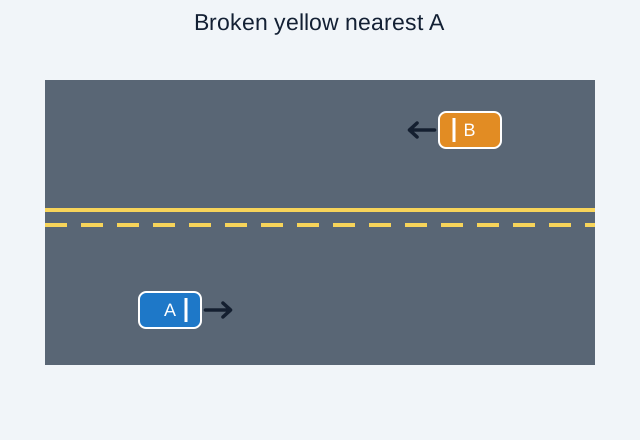
A follows a slower vehicle on a two-way road. The centerline is broken on A’s side and solid on the opposite side. The view ahead is clear. What should happen next?
- A. Pass without checking oncoming traffic.
- B. Use the oncoming shoulder.
- C. Pass only if it is otherwise legal and there is enough safe space.
- D. Stay behind the slow car.
Show answer
Answer: C. Pass only if it is otherwise legal and there is enough safe space.
A broken line on your side permits a pass only when the maneuver is also safe and legal.
Question 2 · Safe Driving and Hazards
An oncoming vehicle approaches while you are using high beams. What should you do?
- A. Leave them on until the other driver dims theirs first, then switch to low beams.
- B. Dim high beams for nearby oncoming or leading vehicles as required.
- C. Keep high beams aimed at the other driver.
- D. Switch off all headlights.
Show answer
Answer: B. Dim high beams for nearby oncoming or leading vehicles as required.
High beams can dazzle other drivers. Use low beams when approaching or closely following traffic.
Question 3 · Parking and Backing
You are about to reverse out of a parking place. What should happen first?
- A. Use the camera as the only check.
- B. Check around the vehicle and blind spots, then back slowly while continuing to observe.
- C. Back quickly before anyone arrives.
- D. Rely on the backup camera alone.
Show answer
Answer: B. Check around the vehicle and blind spots, then back slowly while continuing to observe.
Backing requires direct awareness of people and obstacles; a camera supplements observation.
Question 4 · Signs and Signals

The illustrated STOP sign faces your lane. What is the appropriate response?
- A. Slow down and roll through carefully if no other vehicles or people are in sight.
- B. Stop only when another car arrives.
- C. Come to a complete stop, then yield before proceeding.
- D. Accelerate to clear the junction.
Show answer
Answer: C. Come to a complete stop, then yield before proceeding.
A stop sign requires a full stop. Afterward, check for conflicts and yield before entering.
Question 5 · Sharing the Road
A bicyclist is ahead and an adjacent lane is available for a safe lane change. How should you plan the pass?
- A. Use the horn to force the rider off the road.
- B. Move into another available lane when required and safe; otherwise allow adequate clearance and slow as necessary.
- C. Pass within the same lane as long as the rider stays close to the curb, and keep up your speed so the pass is short.
- D. Pass despite unsafe clearance.
Show answer
Answer: B. Move into another available lane when required and safe; otherwise allow adequate clearance and slow as necessary.
A safe bicycle pass requires compliance with California lane-change and clearance rules; never force a close pass.
Question 6 · Right of Way and Crossings
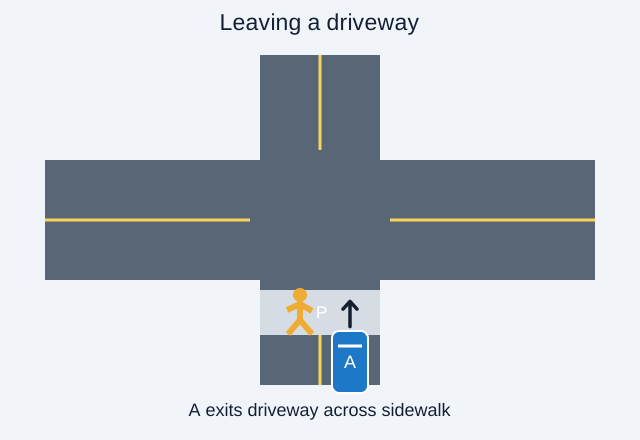
A is leaving a driveway. P is walking along the sidewalk directly across the driveway exit. What should happen next?
- A. P must stop and let A pull out.
- B. A yields to P, since P is already crossing the driveway.
- C. A blocks the sidewalk until P stops.
- D. A edges out slowly so P walks around the car.
Show answer
Answer: B. A yields to P, since P is already crossing the driveway.
A driver crossing a sidewalk must yield to pedestrians and then to roadway traffic.
Question 7 · Permits and Test Preparation
A 16-year-old with a validated instruction permit plans ordinary practice driving. Who must supervise?
- A. Practice with any licensed friend who is 18 or older, as long as they sit in the front passenger seat.
- B. Assume passing the knowledge test permits solo driving.
- C. Practice alone on quiet streets.
- D. Drive only with an eligible adult 25 or older who holds a valid California license riding along.
Show answer
Answer: D. Drive only with an eligible adult 25 or older who holds a valid California license riding along.
A minor's practice must be supervised by a parent, guardian, spouse, driving instructor or other licensed California adult who is 25 or older. A younger licensed friend does not qualify, and passing the written test does not allow solo driving.
Question 8 · Alcohol, Drugs and Distraction
You keep yawning and missing road signs on a long drive. What should you do?
- A. Open the window and turn up the music, then keep going until your next planned stop.
- B. Leave the road at a safe spot and take a real break or nap before driving on.
- C. Turn up music as a substitute for rest.
- D. Drive faster to finish sooner.
Show answer
Answer: B. Leave the road at a safe spot and take a real break or nap before driving on.
Drowsiness slows reactions and can cause brief micro-sleeps. Cold air, music or caffeine only mask it for a moment; real rest is the fix.
Question 9 · Lanes and Turns
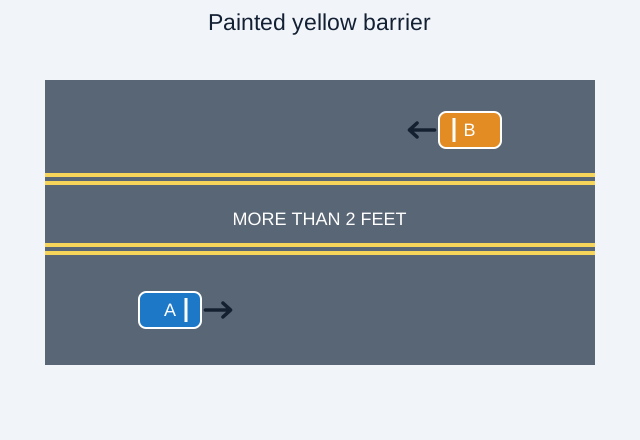
A wants to turn left across a wide painted median. Each edge of the median is a pair of solid yellow lines, and the edges are more than 2 feet apart. No gap is marked. What should happen next?
- A. Cross whenever no car is visible.
- B. Do not cross the painted barrier.
- C. Cross to save distance.
- D. Treat it as an ordinary shared turn lane.
Show answer
Answer: B. Do not cross the painted barrier.
A median outlined this way works like a concrete divider. Don't drive on it or turn across it; use a marked opening further along.
Question 10 · Safe Driving and Hazards
Fog makes the next bend hard to see although the speed-limit sign has not changed. How should you choose your speed?
- A. Keep to the number on the sign in any weather.
- B. Match the fastest vehicle.
- C. Ignore visibility if the road is familiar.
- D. Pick a speed that keeps you in control for the visibility, surface and traffic around you, even if it is under the posted number.
Show answer
Answer: D. Pick a speed that keeps you in control for the visibility, surface and traffic around you, even if it is under the posted number.
California's Basic Speed Law makes the conditions, not just the sign, set your top speed. You can be cited for going the posted limit if fog, rain or crowds make that unsafe.
Question 11 · Parking and Backing
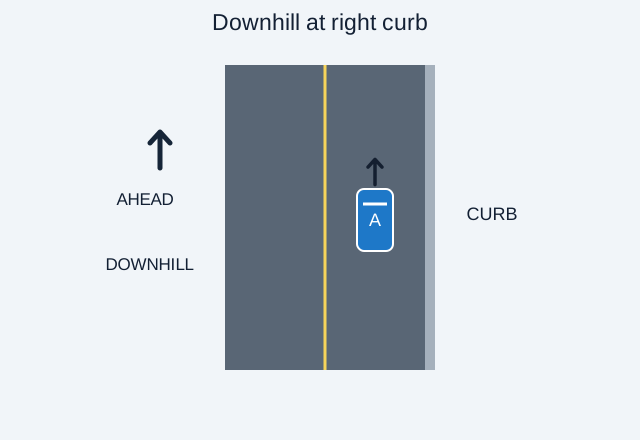
A is parked facing downhill beside a curb on its right. What should happen next?
- A. Turn the front wheels away from the curb so they would roll toward the street, then set the brake.
- B. Rely only on steering lock.
- C. Leave the wheels straight and release the brake.
- D. Steer the front tires in against the curb, then apply the parking brake.
Show answer
Answer: D. Steer the front tires in against the curb, then apply the parking brake.
Facing downhill with a curb on the right, angle the tires into the curb. If the car creeps forward, the curb catches the front wheel instead of letting it roll into the street.
Question 12 · Signs and Signals
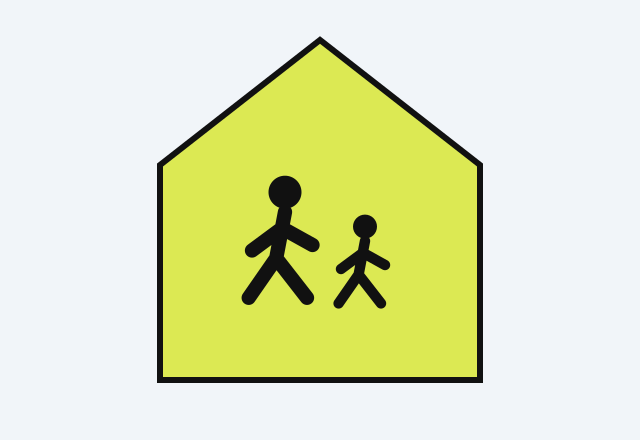
The illustrated SCHOOL sign faces your lane. What is the appropriate response?
- A. Expect children to wait on the curb, and keep moving at the normal speed limit.
- B. Sound the horn instead of slowing.
- C. Look only for cars.
- D. Watch for children and obey crossing guards and posted controls.
Show answer
Answer: D. Watch for children and obey crossing guards and posted controls.
The school warning calls attention to children; posted speed and crossing instructions still govern.
Question 13 · Sharing the Road
A road worker shows a STOP paddle at a single-lane work area. What should you do?
- A. Follow your navigation app's route instead.
- B. Obey the flagger’s directions and temporary traffic controls.
- C. Assume work-zone instructions apply only to trucks.
- D. Drive around a stop paddle if the road looks clear.
Show answer
Answer: B. Obey the flagger’s directions and temporary traffic controls.
A flagger may direct alternating traffic through a temporary lane; follow that control.
Question 14 · Right of Way and Crossings
Your vehicle stalls on railroad tracks. What is the immediate priority?
- A. Try to restart the car or push it off the rails first, then get out if a train comes into view.
- B. Stand on the tracks to signal with your hands.
- C. Stay in the vehicle to protect belongings.
- D. Evacuate everyone well clear of the rails, then phone the railroad's posted emergency number or 911.
Show answer
Answer: D. Evacuate everyone well clear of the rails, then phone the railroad's posted emergency number or 911.
People matter more than the car. Move away from the tracks, angled toward the train's direction so debris won't hit you, then report the blocked crossing.
Question 15 · Permits and Test Preparation
A minor has studied every lesson but has not completed required supervised driving. What is still necessary?
- A. Complete the required supervised practice, including the required night practice.
- B. Nothing more, as long as the practice tests show you know the rules.
- C. Count only simulator time.
- D. Replace practice with mock exam scores.
Show answer
Answer: A. Complete the required supervised practice, including the required night practice.
Minor licensing requires supervised road practice with a night component; app study does not replace it.
Question 16 · Alcohol, Drugs and Distraction
A prescription makes you dizzy before you plan to drive. What should you do?
- A. Use coffee to cancel impairment.
- B. Drive anyway, since a medicine your doctor prescribed can't lead to a DUI.
- C. Assume a prescription prevents a DUI.
- D. Do not drive while impaired; check warnings and arrange another way to travel.
Show answer
Answer: D. Do not drive while impaired; check warnings and arrange another way to travel.
Legal medicines can impair driving. The source of a substance does not make impaired driving safe.
Question 17 · Lanes and Turns
Your freeway exit has a separate deceleration lane. How should you plan to slow?
- A. Cross solid barriers to reach the ramp.
- B. Enter the exit lane safely and reduce speed in the deceleration lane as appropriate.
- C. Stop at the gore point.
- D. Slow down in the through lane first, then move into the exit lane at the ramp speed.
Show answer
Answer: B. Enter the exit lane safely and reduce speed in the deceleration lane as appropriate.
Plan the exit early and use the designated lane to slow without creating unnecessary conflict in through traffic.
Question 18 · Safe Driving and Hazards
A passenger leaves the shoulder belt behind their back for comfort. What should happen before you drive?
- A. Skip restraints for a short trip.
- B. Let them wear the shoulder belt behind their back.
- C. Share one belt between two people.
- D. Make sure the required occupants are properly restrained before driving.
Show answer
Answer: D. Make sure the required occupants are properly restrained before driving.
Proper restraints reduce injury risk. Trip length does not make incorrect belt use safe.
Question 19 · Parking and Backing
You park beside a bicycle route and want to get out. What should you do before opening the door?
- A. Open immediately to claim space.
- B. Ask a passenger to watch for traffic and open the door when they tell you it looks clear.
- C. Look in the mirror and turn to look behind for cyclists and cars, then open the door slowly.
- D. Assume parked cars cannot create a hazard.
Show answer
Answer: C. Look in the mirror and turn to look behind for cyclists and cars, then open the door slowly.
A door swung open into a bike lane is a common cause of serious cyclist injuries. A quick look back first prevents it.
Question 20 · Signs and Signals
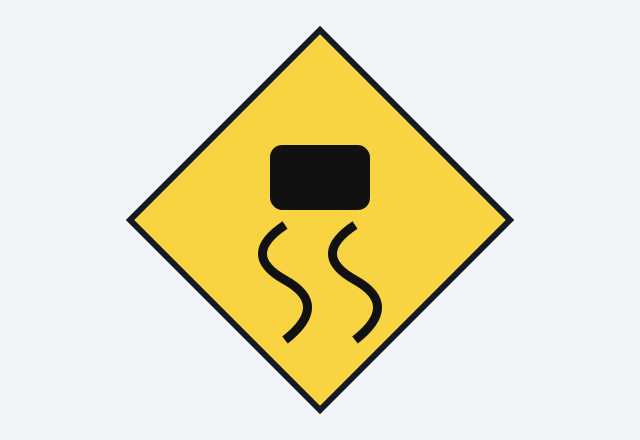
The illustrated SLIPPERY WHEN WET sign faces your lane. What is the appropriate response?
- A. Follow in the tire tracks of the car ahead at your usual distance.
- B. Assume normal traction in rain.
- C. Brake hard to test grip.
- D. Allow extra space and avoid abrupt steering or braking when wet.
Show answer
Answer: D. Allow extra space and avoid abrupt steering or braking when wet.
Water can reduce available grip, so smooth control and additional space are appropriate.
Ready to test yourself?
Take a 20-question practice exam with the answers hidden. You get a score (aim for 16 of 20 or better) and an explanation for every answer. For the DMV’s own test format, see about the permit test.
More free practice and lessons
- Road signs practice test
- Rules of the road practice test
- California DMV Practice Mock Exam 1 with answers
- California DMV Practice Mock Exam 2 with answers
- California DMV Practice Mock Exam 3 with answers
- California DMV Practice Mock Exam 4 with answers
- California DMV Practice Mock Exam 5 with answers
- California DMV Practice Mock Exam 6 with answers
- California DMV Practice Mock Exam 7 with answers
- Signs and Signals
- Right of Way and Crossings
- Lanes and Turns
- Parking and Backing
- Sharing the Road
- Safe Driving and Hazards
- Alcohol, Drugs and Distraction
- Permits and Test Preparation
- About the California permit test
- 7-day study plan
- Permit test tips