California DMV Practice Mock Exam 3
All 20 questions from Mock Exam 3, with answers and explanations.
A mixed exam: 5 sign questions, 5 road diagrams and 10 questions on the rules of the road, including parking and backing, right of way and crossings and lanes and turns.
These are the 20 questions from Mock Exam 3, original practice questions on signs and the rules of the road, checked against the California Driver Handbook. Read through them with Show answer, or take the exam online first with the answers hidden and see your score. No sign-in needed.
These are original practice questions, not actual DMV test questions. Each links to the California Driver Handbook so you can check the rule. Questions were last reviewed in November 2026; read how we write and check them.
Question 1 · Safe Driving and Hazards
A driver is following much too closely on a multilane road. What should you do?
- A. Watch only the rear mirror.
- B. Keep control, leave more room ahead, and let the following driver pass when safe.
- C. Brake sharply a few times so the driver behind gets the message and backs off.
- D. Race the following car.
Show answer
Answer: B. Keep control, leave more room ahead, and let the following driver pass when safe.
A tailgater is a reason to reduce conflict and preserve braking room, not to retaliate.
Question 2 · Safe Driving and Hazards
Your mirror looks clear before a lane change. What additional check is needed?
- A. Use the mirrors, then turn your head to glance into the blind spot on the side you are moving toward.
- B. Turn immediately after signaling.
- C. Trust the mirror: if it shows the lane is empty, there's no vehicle close enough to matter and you can move over.
- D. Rely only on a lane-warning sensor.
Show answer
Answer: A. Use the mirrors, then turn your head to glance into the blind spot on the side you are moving toward.
Mirrors and sensors leave gaps beside and slightly behind the car. A quick head check toward where you're going covers that gap before you move.
Question 3 · Lanes and Turns
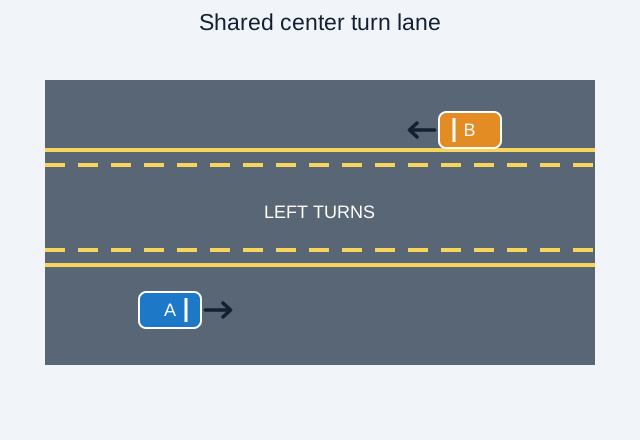
A needs a left turn ahead. The middle lane is marked for left turns by traffic from both directions. What should happen next?
- A. Use the middle lane to prepare for the left turn, not for passing.
- B. Treat it as a normal through lane.
- C. Drive there continuously for several blocks.
- D. Use the middle lane to pass a slow line of traffic, then move back before the turn.
Show answer
Answer: A. Use the middle lane to prepare for the left turn, not for passing.
A shared center turn lane serves turning maneuvers and is not a through or passing lane.
Question 4 · Signs and Signals
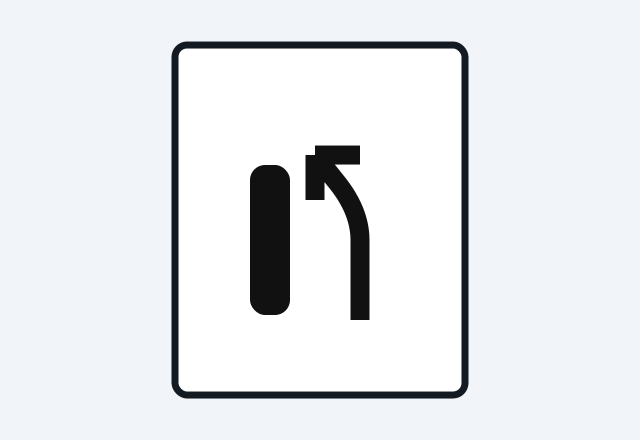
The illustrated KEEP RIGHT sign faces your lane. What is the appropriate response?
- A. Cross into opposing traffic on the left.
- B. Pass on either side of the divider.
- C. Stop beside the divider indefinitely.
- D. Pass to the right of the indicated obstruction or divider.
Show answer
Answer: D. Pass to the right of the indicated obstruction or divider.
Keep-right control directs traffic around the designated obstruction on its right.
Question 5 · Alcohol, Drugs and Distraction
A prescription makes you dizzy before you plan to drive. What should you do?
- A. Use coffee to cancel impairment.
- B. Drive anyway, since a medicine your doctor prescribed can't lead to a DUI.
- C. Assume a prescription prevents a DUI.
- D. Do not drive while impaired; check warnings and arrange another way to travel.
Show answer
Answer: D. Do not drive while impaired; check warnings and arrange another way to travel.
Legal medicines can impair driving. The source of a substance does not make impaired driving safe.
Question 6 · Signs and Signals
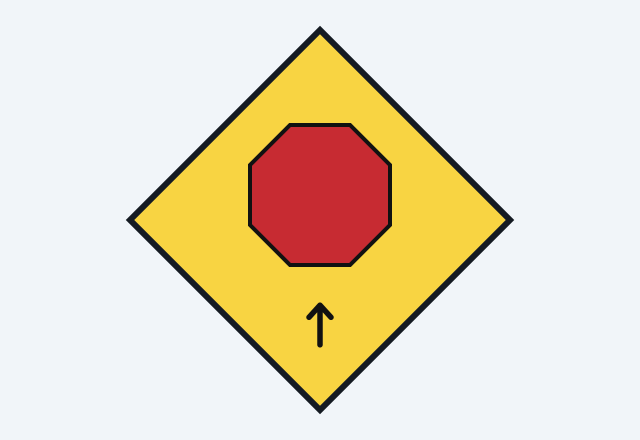
The illustrated STOP AHEAD sign faces your lane. What is the appropriate response?
- A. Prepare to stop at the upcoming stop control.
- B. Ignore the later stop sign.
- C. Stop at this warning sign, then continue through the next intersection.
- D. Accelerate before the junction.
Show answer
Answer: A. Prepare to stop at the upcoming stop control.
The advance warning gives notice of a stop sign farther along the road; the actual control sets the stopping point.
Question 7 · Parking and Backing
You see an ordinary red curb and want to wait for a friend. What rule applies?
- A. Keep moving: a red curb is off-limits even for a brief wait, unless a posted exception covers you.
- B. Wait there whenever the engine remains running.
- C. Wait there briefly with your hazard lights on.
- D. Park for a few minutes with hazards on.
Show answer
Answer: A. Keep moving: a red curb is off-limits even for a brief wait, unless a posted exception covers you.
Red paint marks space that must stay open, such as near hydrants or fire lanes. Running the engine or turning on hazard lights does not make a stop there legal.
Question 8 · Signs and Signals
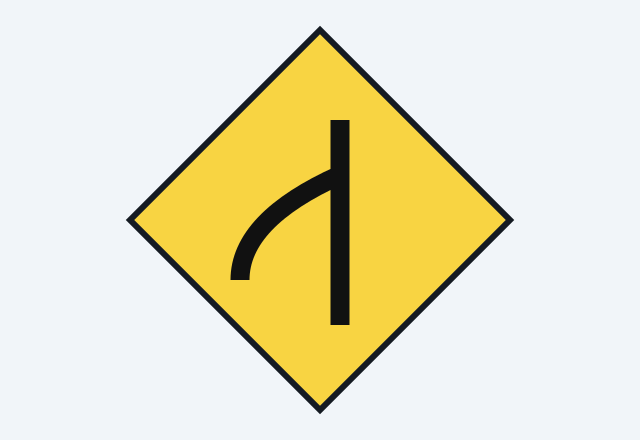
The illustrated MERGE sign faces your lane. What is the appropriate response?
- A. Stop in the through lane so the merging vehicles can enter ahead of you.
- B. Block every merging vehicle.
- C. Assume your lane must end immediately.
- D. Expect joining traffic and adjust spacing safely.
Show answer
Answer: D. Expect joining traffic and adjust spacing safely.
A merge warning means traffic streams will join. Anticipate the conflict and keep a usable gap.
Question 9 · Signs and Signals
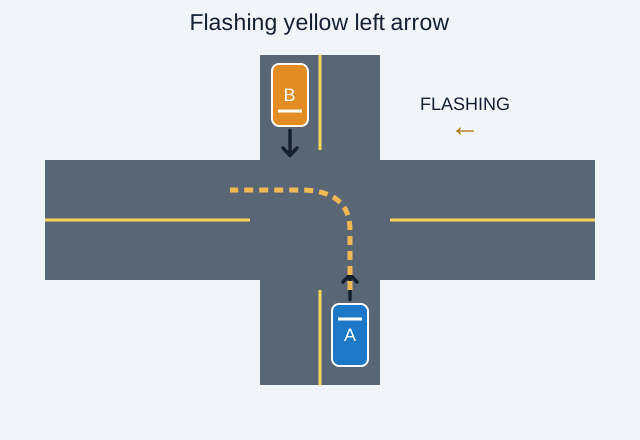
A sees a flashing yellow left arrow. B approaches from the opposite direction on a conflicting through path. What should happen next?
- A. A must wait for B to wave.
- B. A yields to B and turns only when safe.
- C. B must stop for every flashing yellow arrow.
- D. A has a protected turn and proceeds.
Show answer
Answer: B. A yields to B and turns only when safe.
A flashing yellow arrow permits a cautious turn after yielding; it does not provide protection from oncoming traffic.
Question 10 · Signs and Signals
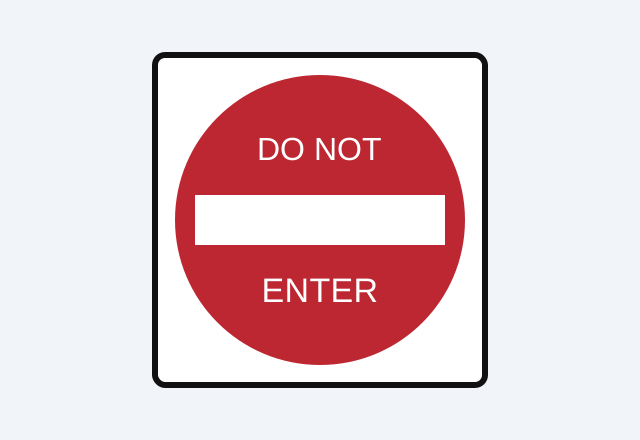
The illustrated DO NOT ENTER sign faces your lane. What is the appropriate response?
- A. Drive through slowly.
- B. Do not enter this roadway from this direction.
- C. Enter only to reach a driveway on this block.
- D. Enter only if the street looks empty and you drive slowly and carefully.
Show answer
Answer: B. Do not enter this roadway from this direction.
This sign prohibits entry from the direction in which it faces approaching traffic.
Question 11 · Permits and Test Preparation
A minor has received an instruction permit but has not begun the required instructor session. What should happen before practice?
- A. Start practicing with a parent right away.
- B. Skip behind-the-wheel instruction.
- C. Assume a friend’s signature validates it.
- D. Wait until the required instructor validation before using the minor’s permit to practice.
Show answer
Answer: D. Wait until the required instructor validation before using the minor’s permit to practice.
A minor’s instruction permit has a driver-training validation requirement before practice use.
Question 12 · Right of Way and Crossings
You are leaving a private driveway for a busy street. Who should you yield to?
- A. Yield to traffic already occupying the roadway or lane you intend to enter.
- B. Enter before checking for bicycles.
- C. Signal, then pull out into the street.
- D. Assume the nearest vehicle will brake.
Show answer
Answer: A. Yield to traffic already occupying the roadway or lane you intend to enter.
Entering traffic must wait for a suitable gap; indicating an intention does not assign priority.
Question 13 · Parking and Backing
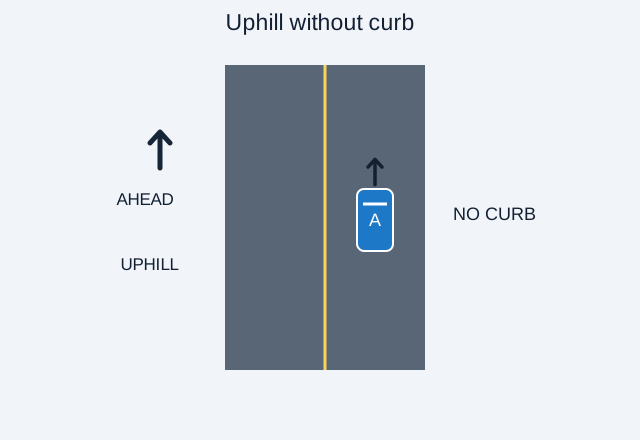
A is parked facing uphill on the right side of a road without a curb. What should happen next?
- A. Keep the wheels straight and omit the brake.
- B. Steer the tires toward the road's edge (to the right) so any roll carries the car off the roadway.
- C. Park facing opposing traffic.
- D. Steer the tires toward the center of the road, the same way you would with a curb uphill.
Show answer
Answer: B. Steer the tires toward the road's edge (to the right) so any roll carries the car off the roadway.
With no curb to catch a wheel, aim the tires toward the shoulder. If the brake slips, the car drifts off the edge rather than into passing traffic.
Question 14 · Right of Way and Crossings
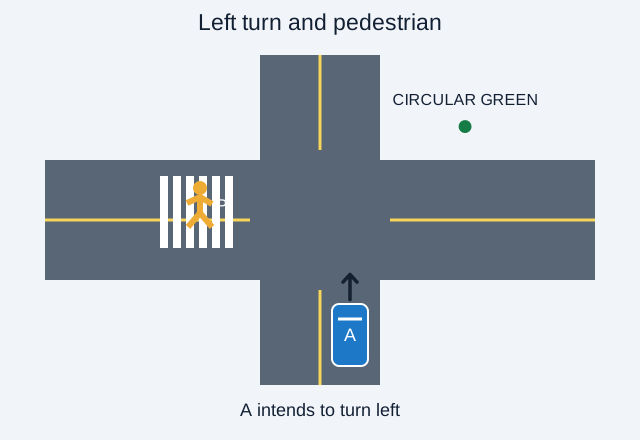
A has a green circular signal and wants to turn left. P is already crossing the destination street in A’s path. What should happen next?
- A. A yields to P before completing the turn.
- B. A turns in front of P because the light is green.
- C. A ignores P if the countdown is low.
- D. A forces P to retreat.
Show answer
Answer: A. A yields to P before completing the turn.
A green signal does not remove the obligation to yield to pedestrians in the turning path.
Question 15 · Parking and Backing
After parallel parking on a normal permitted street, how should your car be positioned relative to the curb?
- A. Line the car up with the curb so the curb-side tires sit 18 inches or closer to it.
- B. Leave a couple of feet between the car and the curb so the door and tires don't scrape it.
- C. Block a driveway to get closer to the curb.
- D. Park diagonally into a travel lane.
Show answer
Answer: A. Line the car up with the curb so the curb-side tires sit 18 inches or closer to it.
Sitting far from the curb pushes the car into the travel lane, where passing vehicles and cyclists can hit it.
Question 16 · Sharing the Road
The amber lights on the school bus in front of you start blinking. What is your best move?
- A. Ignore the bus unless children are visible.
- B. Ease off the gas and get ready to halt behind the bus.
- C. Speed up and pass the bus before it stops, so you don't get held up behind it.
- D. Move into the opposing lane immediately.
Show answer
Answer: B. Ease off the gas and get ready to halt behind the bus.
Amber lights on a school bus are an early warning that it is about to halt and that children may soon be getting on or off. Reduce speed now so you can stop smoothly if the red lights come on.
Question 17 · Lanes and Turns
A hill blocks your view of opposing traffic on a two-way road. Should you begin a pass?
- A. Pass on a blind curve by sounding the horn.
- B. Yes, begin the pass if the vehicle ahead is very slow, and finish it quickly before the top of the hill.
- C. Rely on the lead driver to warn of oncoming traffic.
- D. Wait until the view and available space make the entire pass legal and safe.
Show answer
Answer: D. Wait until the view and available space make the entire pass legal and safe.
Permission from markings alone does not ensure enough clear distance for an overtaking maneuver.
Question 18 · Right of Way and Crossings
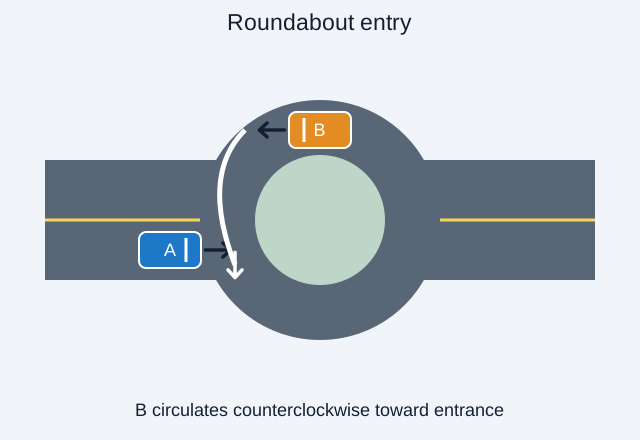
A is waiting at the roundabout entrance. B is circulating toward that entrance. What should happen next?
- A. A enters because entering traffic has priority.
- B. A enters against the circular flow.
- C. A yields to B, because traffic already in the roundabout goes first.
- D. B stops for A.
Show answer
Answer: C. A yields to B, because traffic already in the roundabout goes first.
Traffic already circulating has priority over entering traffic.
Question 19 · Signs and Signals
The light turns yellow when you still have room for a smooth safe stop. What should you do?
- A. Accelerate whenever yellow appears.
- B. Halt at the line when a smooth stop is possible; if you are already too close, continue through carefully.
- C. Brake hard and stop at the line every time the light turns yellow, however close you are and whoever is behind you.
- D. Treat yellow as a fresh green.
Show answer
Answer: B. Halt at the line when a smooth stop is possible; if you are already too close, continue through carefully.
A steady yellow tells you the red is coming. Judge whether you can come to a controlled stop before the line. If braking hard would be dangerous, carry on through with care instead of speeding up.
Question 20 · Signs and Signals
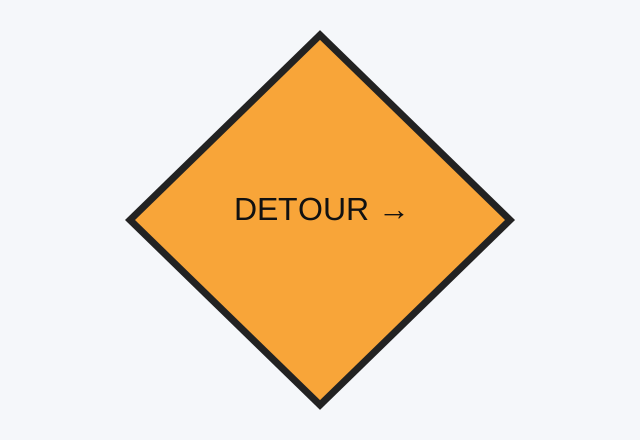
The illustrated DETOUR → sign faces your lane. What is the appropriate response?
- A. Travel against traffic to bypass the closure.
- B. Ignore the temporary signs and use your GPS to find the fastest route.
- C. Drive around the closure barriers.
- D. Follow the signed alternate route in the indicated direction.
Show answer
Answer: D. Follow the signed alternate route in the indicated direction.
A detour routes traffic around a disruption. Follow the temporary signs and other controls.
Ready to test yourself?
Take a 20-question practice exam with the answers hidden. You get a score (aim for 16 of 20 or better) and an explanation for every answer. For the DMV’s own test format, see about the permit test.
More free practice and lessons
- Free California DMV practice test
- Road signs practice test
- Rules of the road practice test
- California DMV Practice Mock Exam 1 with answers
- California DMV Practice Mock Exam 2 with answers
- California DMV Practice Mock Exam 4 with answers
- California DMV Practice Mock Exam 5 with answers
- California DMV Practice Mock Exam 6 with answers
- California DMV Practice Mock Exam 7 with answers
- Signs and Signals
- Right of Way and Crossings
- Lanes and Turns
- Parking and Backing
- Sharing the Road
- Safe Driving and Hazards
- Alcohol, Drugs and Distraction
- Permits and Test Preparation
- About the California permit test
- 7-day study plan
- Permit test tips